


If you have recently been told you have spinal stenosis, you may be asking yourself three very normal questions:
- Why this?
- Why now?
- Why me?
- Maybe your back pain has been getting worse.
- Maybe your legs feel heavy when you walk.
- Maybe you feel better when you sit down or lean forward.
- Maybe grocery shopping is easier when you lean on the cart.
- Maybe standing in one place is harder than walking.
- Maybe your doctor told you that your spinal canal is narrowing, your nerves are crowded, or your spine is showing wear and tear.
And now you are wondering what that actually means.
At Fairway Chiropractic Centre in Kitchener, we see many patients with spinal stenosis who are trying to understand their options. Some are hoping to avoid surgery. Some are trying to stay active. Some are frustrated because they feel like their body is aging faster than they expected, or that their body has failed them.
The good news is this:
A diagnosis of spinal stenosis does not automatically mean you need surgery.
But it does mean your spine needs to be understood properly.
Quick Answer
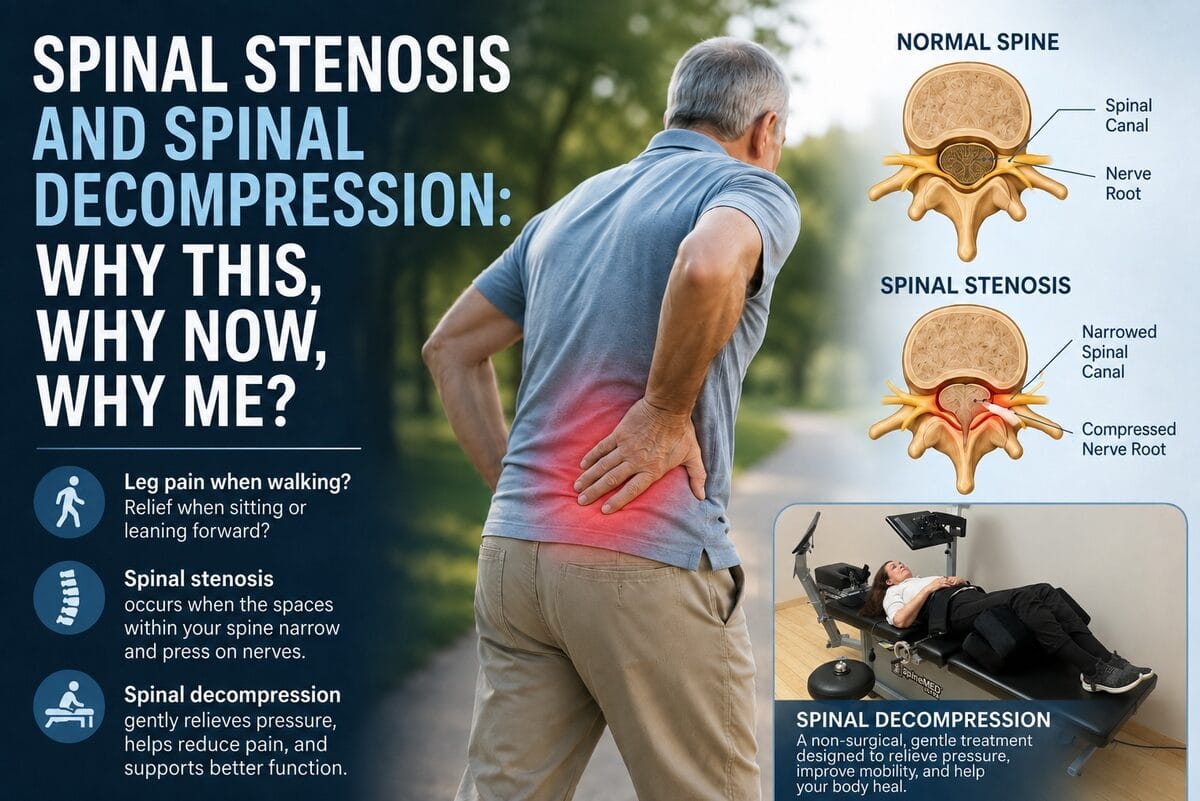
Spinal stenosis means there is narrowing within the spine that can place pressure on the spinal cord or nerves.
In the lower back, spinal stenosis can cause back pain, leg pain, heaviness, numbness, tingling, weakness, or difficulty walking. Many people with lumbar spinal stenosis feel worse when standing or walking and better when sitting or bending forward.
Spinal decompression may be considered for certain patients with spinal stenosis because the goal is to gently reduce mechanical stress on irritated spinal structures and support better function.
But spinal decompression is not right for everyone.
The most important step is a proper assessment to determine what type of stenosis you have, how severe it is, what is irritating your symptoms, and whether non-surgical spinal decompression may be an appropriate option.
What Is Spinal Stenosis?
Spinal stenosis is a narrowing of the spaces within the spine.
These spaces are important because they are where the spinal cord and spinal nerves travel.
When those spaces become smaller, the nerves can become crowded or irritated.
Spinal stenosis can occur in the neck or low back, but this blog focuses mostly on lumbar spinal stenosis, which affects the lower back.
Lumbar spinal stenosis can cause symptoms in the back, buttocks, hips, thighs, calves, or feet.
- Some people feel pain.
- Some feel numbness or tingling.
- Some feel heaviness, weakness, or fatigue in the legs.
- Some people say their legs feel like they “just do not want to go.”
- Others say they can walk only a certain distance before they need to sit down.
Why This?
Many patients ask:
“Why did I get spinal stenosis?”
Most spinal stenosis develops gradually over time.
It is often related to degenerative changes in the spine. That can include disc degeneration, loss of disc height, arthritis in the spinal joints, thickening of ligaments, bone spurs, or changes in the alignment and mechanics of the spine.
This does not mean you did something wrong.
It also does not mean your spine is broken.
It means your spine has changed over time, and those changes may now be affecting the nerves.
In many people, spinal stenosis is the result of years of small stresses adding up:
- Years of sitting
- Years of bending
- Years of physical work
- Years of sports or old injuries
- Years of poor posture
- Years of spinal stiffness
- Years of repetitive loading
- Years of weakened spinal support
The spine adapts to what we repeatedly do.
Sometimes those adaptations protect us.
Sometimes they eventually create crowding, stiffness, irritation, and pain.
Why Now?
This is one of the most frustrating parts of spinal stenosis.
Many people with spinal stenosis say:
“I have probably had this for years. So why is it bothering me now?”
That is a great question.
Spinal stenosis often develops slowly, but symptoms may show up suddenly or worsen during a specific season of life.
That may happen because the spine has reached a tipping point.
For years, your body may have been compensating. Your muscles, joints, discs, and nervous system found ways to work around the narrowing.
But then something changes.
- You sit more.
- You walk less.
- You gain weight.
- You stop exercising.
- You do more yard work.
- You shovel snow.
- You take a long car trip.
- You have a fall.
- You lift something awkwardly.
- You go through a stressful season.
- You lose strength in your hips, core, or legs.
- Your posture changes.
- Your disc height decreases further.
- Your spinal joints stiffen more.
Suddenly, the body can no longer compensate the same way.
The stenosis may have been developing for a long time, but the symptoms may feel new because your body has finally reached its limit.
In other words, spinal stenosis is often not a sudden problem.
It is a slow problem that finally got loud enough to get your attention.
Why Me?
This is another common question.
“Why me?”
The honest answer is that spinal stenosis is common, especially as people get older.
But common does not mean insignificant.
And it does not mean you should just accept it.
- Some people develop spinal stenosis because of age-related changes.
- Some because of genetics.
- Some because they were born with a smaller spinal canal.
- Some because of old injuries.
- Some because of years of physical work.
- Some because of repeated spinal loading.
- Some because of degenerative disc disease, arthritis, scoliosis, or other spinal changes.
Most of the time, it is not just one thing.
It is a combination.
The more useful question may be:
“What is contributing to my symptoms now, and what can I do about it?”
That is where a proper assessment becomes so important.
The Classic Spinal Stenosis Pattern
Spinal stenosis does not always behave the same way as a simple muscle strain.
A very common pattern with lumbar spinal stenosis is:
- Worse with standing
- Worse with walking
- Better with sitting
- Better with leaning forward
- Better when leaning on a shopping cart
- Better on a stationary bike than walking upright
This happens because the position of the spine can influence the space available for the nerves.
Many stenosis patients feel worse when the low back is extended, such as standing upright or walking downhill.
They often feel better when the spine is slightly flexed, such as sitting, bending forward, or leaning on a cart.
This is why some people with spinal stenosis can bike longer than they can walk.
It is not that the legs are simply weak.
It may be that the nerves are being irritated by position and loading.
Why Would Spinal Decompression Help Spinal Stenosis?
This is an important question.
If spinal stenosis means narrowing, why would spinal decompression be considered?
Spinal decompression is designed to gently reduce compressive stress through the spine. In the right patient, the goal is to reduce pressure on irritated discs, joints, and nerve-related structures.
With spinal stenosis, the problem may involve several things at once:
- Loss of disc height
- Bulging discs
- Degenerative disc disease
- Arthritic spinal joints
- Inflamed or irritated nerve roots
- Poor spinal mechanics
- Muscle guarding
- Reduced tolerance to standing and walking
Spinal decompression does not magically remove arthritis or bone spurs.
It does not instantly reverse years of degeneration.
But in the right case, it may help reduce mechanical stress on the spine and create a better environment for comfort, movement, and function.
That is why we do not present spinal decompression as a magic cure.
We see it as one possible tool in a larger plan.
Spinal Decompression Is Not Right for Everyone With Spinal Stenosis
This is very important.
Not every person with spinal stenosis is a good candidate for spinal decompression.
- Some people may need Chiropractic care.
- Some may need spinal decompression.
- Some may need SoftWave Tissue Regenerative Therapy if there are other soft tissue or joint-related issues.
- Some may need specific exercises and movement coaching.
- Some may need medical management.
- Some may need a surgical opinion.
- Some may need urgent medical care if there are serious neurological symptoms.
The diagnosis alone does not decide the treatment.
The person does.
Your symptoms, exam findings, health history, imaging, goals, severity, and function all matter.
When Spinal Decompression May Be Considered
Spinal decompression may be considered when spinal stenosis is associated with disc degeneration, disc height loss, nerve irritation, back pain, leg symptoms, or mechanical compression that appears appropriate for non-surgical care.
It may be especially worth discussing if you have:
- Low back pain with leg symptoms
- Pain that worsens with standing or walking
- Symptoms that improve with sitting or leaning forward
- Degenerative disc disease
- Disc bulging along with stenosis
- Sciatica-like symptoms
- Limited walking tolerance
- Recurring flare-ups
- A desire to explore non-surgical options before considering surgery
Again, this does not mean spinal decompression is automatically right for you.
It means it may be worth assessing.
What Spinal Decompression Cannot Do
Spinal decompression should be explained honestly.
- It cannot guarantee surgery will be avoided.
- It cannot instantly rebuild a severely degenerated spine.
- It cannot remove large bone spurs.
- It cannot cure every type of stenosis.
- It cannot replace urgent medical care when serious neurological symptoms are present.
- It cannot fix the problem if your daily mechanics keep re-irritating the spine.
This is why our approach is not just about getting someone on a decompression table.
It is about understanding the cause, reducing the stress, improving function, and giving the body the best opportunity to heal.
What Makes Our Approach Different
At Fairway Chiropractic Centre and Disc Repair Clinic in Kitchener, we look at spinal stenosis from a whole-spine and whole-person perspective.
We want to understand:
- Why are your symptoms showing up now?
- What positions make you worse?
- What positions make you better?
- How far can you walk?
- Can you stand comfortably?
- Do your symptoms travel into the legs?
- Do you have numbness or tingling?
- Do you have weakness?
- What does your imaging show?
- What have you already tried?
- Are you trying to avoid surgery?
- What does your daily life require from your spine?
Spinal stenosis is not just an MRI finding.
It is a real-life problem when it affects your walking, sleeping, working, exercising, independence, and confidence.
Why Chiropractic Care May Also Matter
Spinal stenosis is often affected by spinal mechanics.
If certain areas of the spine are stiff, restricted, overloaded, or moving poorly, the surrounding tissues may experience more stress.
Chiropractic care may be used when appropriate to help improve spinal motion, reduce mechanical stress, and support better function. If you are looking for a chiropractor in Kitchener who understands spinal stenosis, that assessment-first approach is what we offer.
This does not mean every stenosis patient is adjusted the same way.
- Some patients need very gentle care.
- Some need decompression first.
- Some need specific movement coaching.
- Some need stabilization.
- Some need to avoid certain positions.
The goal is not to force the spine.
The goal is to help the spine function better with the least appropriate amount of stress.
Why Exercises Need to Be Chosen Carefully
Exercise can be very helpful for spinal stenosis, but the right exercises matter.
Some stenosis patients feel better with flexion-based movements, walking modifications, cycling, hip mobility, core endurance, or supported positions.
Others may worsen if they force too much extension, aggressive stretching, or the wrong type of strengthening too soon.
The goal is not just to exercise more.
The goal is to exercise smarter.
A good plan should help you improve strength, endurance, movement tolerance, and confidence without constantly flaring your symptoms.
Why Waiting Too Long Can Be a Problem
Spinal stenosis can slowly shrink a person’s life.
- At first, you stop walking as far.
- Then you avoid standing in lines.
- Then you stop shopping unless you have a cart.
- Then you avoid travel.
- Then you stop exercising.
- Then your legs get weaker.
- Then your confidence drops.
- Then your world gets smaller.
This is why it is important to pay attention early.
The goal is not to panic.
The goal is to act before the problem controls more of your life.
When to Seek Medical Attention Quickly
Some symptoms should not be ignored.
Seek urgent medical attention if you experience:
- New or worsening loss of bladder or bowel control
- Numbness in the groin or saddle area
- Progressive leg weakness
- Severe or rapidly worsening symptoms
- Difficulty walking that is suddenly getting worse
- Severe pain after a fall or trauma
- Fever with severe back pain
These symptoms may require urgent medical evaluation.
So, Why This, Why Now, Why Me?
Why this?
Because the spaces around the nerves in your spine may have narrowed, often due to degenerative changes, disc height loss, arthritis, or long-term spinal loading.
Why now?
Because your body may have reached a tipping point. The stenosis may have been developing for years, but your symptoms may have appeared once your spine could no longer compensate.
Why me?
Because spinal stenosis is common, especially with age and degenerative spinal changes. But your symptoms, your mechanics, your history, and your goals are unique.
The more important question is:
“What can I do now?”
Is Spinal Decompression Worth Considering?
If spinal stenosis is limiting your walking, affecting your legs, disturbing your sleep, or making you worry about your future, spinal decompression may be worth discussing.
It may not be the right answer for everyone.
But for the right patient, it may be part of a non-surgical plan to reduce spinal stress, improve function, and help the body settle. You can read some of our patients’ experiences on our spinal decompression success stories page.
At Fairway Chiropractic Centre, our goal is not to sell everyone the same treatment.
Our goal is to find out what is causing your problem and give you your best options on how to let your body heal.
Book a New Patient Appointment
If you have spinal stenosis and are wondering whether spinal decompression may be appropriate for you, you can book a new patient appointment with Fairway Chiropractic Centre in Kitchener. We help people from Kitchener, Waterloo, Cambridge, and the surrounding area decide whether this may be the right next step. You can also call us at 519-748-5535.
About the Author
Dr. Nik Dukovac, B.Sc., D.C.
Chiropractor | Fairway Chiropractic Centre | Kitchener, Ontario
Dr. Nik Dukovac has advanced training in spinal neurobiomechanics and has spent nearly two decades helping patients with disc-related injuries, sciatica, chronic back pain, spinal stenosis, and degenerative disc disease. He is only interested in 2 things: Finding out what is causing your problem, and giving you your best options on how to let your body heal.
References and Further Reading
- National Institute of Arthritis and Musculoskeletal and Skin Diseases. Spinal Stenosis.
- MedlinePlus. Spinal Stenosis.
- Mayo Clinic. Spinal Stenosis: Symptoms and Causes.
- American Academy of Orthopaedic Surgeons. Lumbar Spinal Stenosis.
- Ammendolia C, et al. Non-Surgical Interventions for Lumbar Spinal Stenosis Leading To Neurogenic Claudication: A Clinical Practice Guideline. Journal of Pain. 2021.
- StatPearls. Spinal Stenosis and Neurogenic Claudication.