


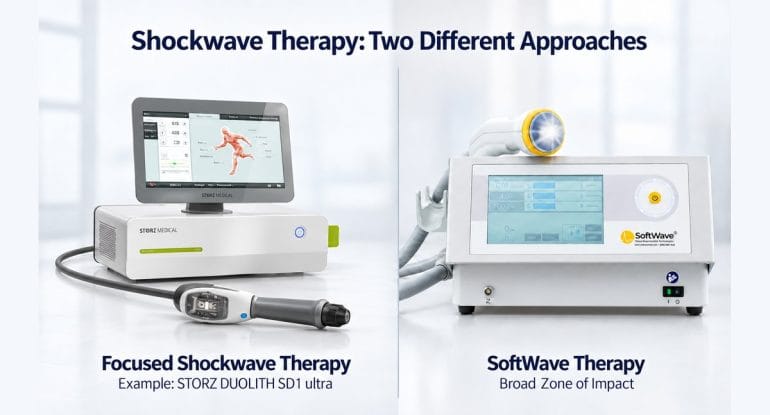
SoftWave is a type of shockwave therapy that sends short pulses of energy into painful or injured tissue to encourage the body’s natural healing response. Many shockwave machines concentrate that energy on one small spot, similar to a laser beam. SoftWave spreads it through a much broader area, more like a floodlight. According to the manufacturer, this area can be about 7 cm wide and reach up to 12 cm deep. This wider reach does not make SoftWave the best choice for every problem, but it may be helpful when an injury involves a larger area, lies deeper beneath the skin, or is difficult to pinpoint precisely. [7]
The most accurate comparison is not “SoftWave versus shockwave.” SoftWave is shockwave therapy. The useful question is which type of shockwave device is being used, how it delivers energy and whether that approach fits the condition being treated.
What Shockwave Therapy Is
Extracorporeal shockwave therapy, usually shortened to ESWT, sends short acoustic pressure waves from a device outside the body into a treatment area. In musculoskeletal care, the goal is not to break tissue apart as shockwaves do when used for kidney stones. The aim is to create a controlled mechanical stimulus that cells can convert into biological signals, a process known as mechanotransduction. [1] [2]
Research has associated ESWT with changes in pain signalling, local circulation, blood-vessel formation, inflammatory regulation and tissue remodelling. These mechanisms are still being studied, and no single explanation accounts for every clinical effect. [1] [2]
Shockwave Is a Category, Not One Machine
The term shockwave therapy is used loosely. Devices may differ in how they generate energy, how deeply that energy travels, where it is strongest and how large an area it reaches. Two clinics can both advertise shockwave therapy while using equipment that behaves quite differently.
| Technology | Typical energy pattern | What that may mean clinically |
|---|---|---|
| Radial pressure wave | Energy is strongest at the applicator and fades as it spreads outward through shallow, more superficial tissue. Analogy: | Often useful for broad, relatively superficial muscle and tendon areas. Although commonly marketed as shockwave, its physics differ from a true focused shockwave. |
| Conventional Focused Shockwave | Energy converges into a smaller focal region at a selected depth. How it works: Analogy: | Can be useful when a clinician wants to target a defined structure or small area, including certain calcifications or specific small lesions. |
| SoftWave Broad Zone electrohydraulic shockwave | A spark generated in water creates acoustic waves. A parabolic reflector directs them in a broad, more parallel treatment field. How it works: Analogy: | Distributes mechanical stimulation across a wider zone and may suit larger, deeper or less sharply defined painful injury areas. |
How SoftWave Differs
SoftWave uses electrohydraulic spark-gap technology. A high-voltage spark inside a water-filled applicator produces an acoustic wave, and a parabolic reflector directs that wave through the treatment head into the body. This is a real shockwave, not therapeutic ultrasound and not a laser. The manufacturer describes the resulting field as broad-focused, unfocused or parallel, depending on the applicator and technical document. [7] [8]
The phrase “broad zone of impact” is often easier to understand. It means the therapeutic field is not designed to converge at one very small point. SoftWave reports a field approximately 7 cm wide and up to 12 cm deep. Those figures come from the manufacturer and should be understood as device specifications rather than a promise that every tissue within that volume receives an identical dose or will respond the same way. Acoustic measurements are commonly made under controlled conditions, and wave behaviour changes as it passes through skin, fat, muscle, tendon and bone. [5] [7]
A Clearer Way to Picture the Treatment Field
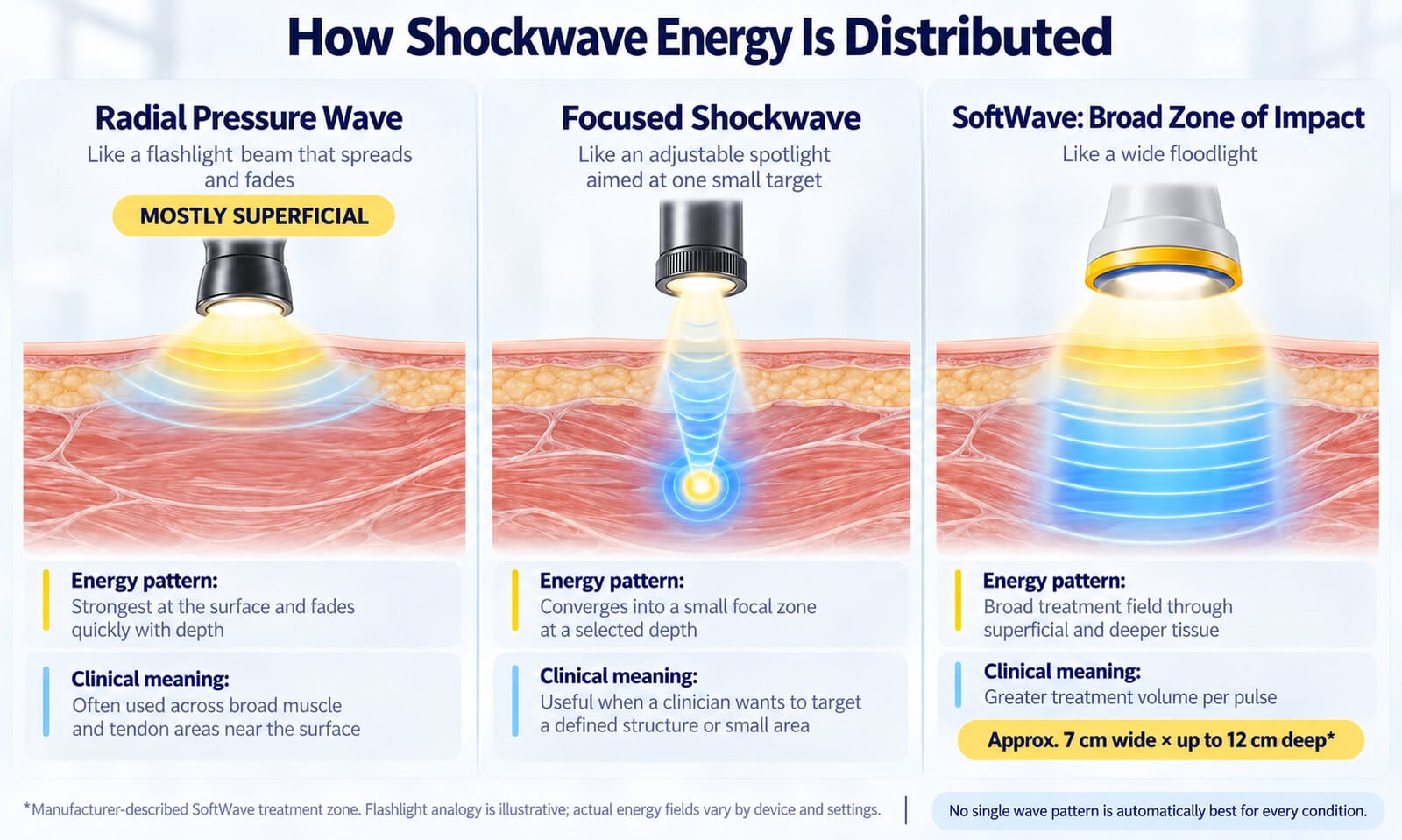
The illustration highlights the main difference in simple terms. Radial pressure waves are strongest at the applicator and lose energy as they spread, so they are generally used for more superficial treatment areas. That does not mean radial therapy is ineffective; it means its energy pattern and typical treatment depth differ from a focused shockwave.
Focused shockwave can reach deeper tissue, but it concentrates energy within a relatively small focal zone. SoftWave’s stated distinction is not simply depth: its broad zone of impact is designed to cover a larger treatment volume through superficial and deeper tissue. According to the manufacturer, that field is approximately 7 cm wide and reaches up to 12 cm deep. Which pattern is most suitable depends on the diagnosis, tissue depth and treatment goal. The flashlight comparison is an analogy; acoustic waves do not behave exactly like visible light. [7]
Does Shockwave Therapy Work by Causing Microtrauma?
Some explanations say shockwave therapy works by creating microtrauma so the body restarts healing. That description is incomplete. Shockwaves do apply mechanical stress, and higher energy can produce cavitation and microscopic tissue effects. Current research, however, places more emphasis on mechanotransduction: cells sense a mechanical stimulus and respond through signalling pathways that may influence circulation, inflammation, pain and tissue repair. [1]
SoftWave’s broad treatment field is intended to distribute energy instead of concentrating it into a small focal point. It is reasonable to say that SoftWave does not depend on deliberately creating concentrated microtrauma as its treatment strategy. It would be too absolute to claim that SoftWave creates no cellular stress under any setting, or that every other shockwave device damages tissue. The biological effect depends on the device, energy level, pulse count, applicator, tissue and individual patient.
SoftWave is also sometimes described as recruiting stem cells. A more responsible description is that shockwave stimulation may start a signalling cascade that influences local repair cells and circulating progenitor cells. SoftWave is not a stem-cell injection, and patients should not be promised that it will regrow cartilage, replace a torn tendon or regenerate every damaged structure. [1]
What the Research Says
The evidence should be separated into two questions. First, does extracorporeal shockwave therapy help certain musculoskeletal problems? Second, has the SoftWave device itself been tested as thoroughly as the entire ESWT category? The answer to the first question is stronger than the answer to the second. [2] [5]
Systematic reviews support ESWT for some conditions, especially chronic plantar heel pain, while results are more mixed for Achilles and patellar tendinopathy. A 2023 systematic review found high-quality evidence of meaningful benefit for plantar fasciitis but low-to-moderate evidence of little or uncertain benefit for patellar and Achilles tendinopathy. A separate 2024 meta-analysis reported pain reduction across several tendinopathies, but also found substantial differences among studies, which limits how confidently one result can be applied to every patient or protocol. [3] [4]
SoftWave-specific clinical research is more limited. A retrospective study of 108 patients, representing 119 treated heels, used the OrthoGold 100 device for chronic plantar fasciitis. Average pain scores improved from 6.7 to 2.6, and 81.5 percent of patients reported satisfaction at follow-up. Those findings are encouraging, but the study had no sham-treatment control group and cannot prove that the device alone caused the improvement. [6]
This is why a balanced answer matters. SoftWave has a plausible mechanism, a distinct delivery pattern and encouraging clinical data. It should still be presented as one treatment option rather than a guaranteed cure. The best candidates are selected after a diagnosis, an examination and a discussion of reasonable alternatives.
Conditions Commonly Treated With Shockwave Therapy
Depending on the diagnosis and device, shockwave therapy may be considered for:
- Plantar fasciitis and chronic heel pain
- Calcific or non-calcific rotator cuff tendinopathy
- Tennis elbow and golfer’s elbow
- Achilles and patellar tendinopathy
- Greater trochanteric pain syndrome
- Chronic muscle or tendon injuries
- Pain and functional limitations associated with knee osteoarthritis
Evidence quality is not equal across this list. The name of the condition alone also does not establish that shockwave therapy is appropriate. Pain can come from a nerve, joint, tendon, muscle, referred spinal source or another medical problem, and each may require a different plan.
What Treatment Feels Like
The applicator is placed against the skin with coupling gel. Patients usually feel rapid tapping or pulsing. A healthy area may feel mild, while a sensitive or injured area can feel sharper. Intensity should be adjusted to the patient and the treatment goal. At Fairway Chiropractic Centre, a SoftWave treatment is typically brief — 15 minutes or less per body region — and is adapted to the patient’s case and comfort level.
Temporary soreness, redness, bruising, swelling or a short-lived increase in pain can occur after ESWT. Serious complications are uncommon when an appropriate device is used by a trained provider and contraindications are respected. [2] [5]
Who Should Be Cautious
Shockwave therapy is not appropriate over every body region or for every patient. Important precautions or contraindications may include pregnancy, an active infection in the treatment area, a malignant tumour in the treatment field, a significant bleeding disorder, anticoagulant use, active bleeding, or treatment near vulnerable lung, brain, nerve or growth-plate tissue at certain energy levels. Implanted electrical devices and recent injections or procedures should also be discussed before treatment. [2] [5]
This is not a complete screening list. A qualified provider should review the patient’s medical history, medications, diagnosis and treatment location before recommending therapy.
How to Compare Shockwave Therapy Providers in Kitchener
If you are comparing shockwave therapy in Kitchener, ask questions that reveal more than the brand name:
- What exact device and applicator will be used?
- Is it radial pressure wave, conventional focused shockwave or a broad-field electrohydraulic system (also known as SoftWave)?
- What diagnosis is being treated, and how was that diagnosis reached?
- What evidence supports shockwave therapy for this specific condition?
- How will progress be measured, and when will the plan be reconsidered if it is not helping?
- What side effects, precautions and alternatives apply to me?
- Will treatment be combined with load management, exercise, rehabilitation or another appropriate form of care?
A trustworthy provider should be able to explain why a particular device fits the problem, what uncertainty remains and what outcome would count as meaningful improvement.
Frequently Asked Questions
Is SoftWave really shockwave therapy?
Yes. SoftWave is an electrohydraulic form of extracorporeal shockwave therapy. Its distinguishing feature is the wider, more parallel acoustic field created by its applicator and reflector design.
Is SoftWave the same as radial shockwave?
No. Radial pressure-wave devices produce their strongest pressure near the skin and disperse energy outward. SoftWave generates a true acoustic shockwave in water and directs it through a broader, deeper field.
Is a broad treatment field always better?
No. A broad field may be useful for a larger, deeper or less clearly defined region. A small, precise target may call for a different device. The diagnosis and treatment objective should guide the choice.
Does SoftWave cause microtrauma?
SoftWave is designed to create a therapeutic mechanical signal without concentrating energy into one tiny focal zone. It is more accurate to say that it does not rely on deliberately creating concentrated microtrauma. No responsible provider should promise that any mechanical therapy creates zero cellular stress under every setting.
Can SoftWave recruit stem cells?
Laboratory and preclinical research suggests that shockwave stimulation can influence signalling pathways involved in repair and may affect progenitor or regenerative cells. SoftWave should not be described as stem-cell therapy, and this mechanism does not guarantee tissue regeneration in an individual patient.
How many SoftWave sessions will I need?
There is no universal schedule. The condition, how long it has been present, tissue involved, treatment dose and response all matter. A provider should recommend a plan only after an assessment and should track whether it is producing meaningful change.
Can SoftWave regrow cartilage or guarantee that I avoid surgery?
Current evidence does not support promising cartilage regrowth or guaranteed avoidance of surgery. Some patients may improve enough to delay or avoid more invasive care, but others may need additional treatment, imaging, medication, injections or surgical consultation.
Shockwave Therapy in Kitchener at Fairway Chiropractic Centre
Fairway Chiropractic Centre uses the SoftWave OrthoGold system for selected musculoskeletal and soft-tissue problems. We serve patients from Kitchener, Waterloo, Cambridge and surrounding communities. Our first step is to understand what is causing the problem and whether SoftWave is a reasonable option for that diagnosis.
Learn more about SoftWave Therapy at Fairway Chiropractic Centre or request a new patient appointment. As a chiropractor in Kitchener-Waterloo, that assessment is where every plan starts. You can also call us at 519-748-5535. Fairway Chiropractic Centre, 5 Manitou Dr, Kitchener, 519-748-5535.
This article provides general education and is not a diagnosis or a substitute for individual medical advice.
About the Author
Dr. Nik Dukovac, B.Sc., D.C.
Chiropractor | Fairway Chiropractic Centre | Kitchener, Ontario
Dr. Nik Dukovac has advanced training in spinal neurobiomechanics and has spent nearly two decades helping patients with disc-related injuries, sciatica, chronic back pain, spinal stenosis, and degenerative disc disease. He is only interested in 2 things: Finding out what is causing your problem, and giving you your best options on how to let your body heal.
References and Further Reading
- Simplicio CL, et al. Extracorporeal shock wave therapy mechanisms in musculoskeletal regenerative medicine. Journal of Clinical Orthopaedics and Trauma. 2020. PubMed
- Tenforde AS, et al. Best practices for extracorporeal shockwave therapy in musculoskeletal medicine. PM&R. 2022. PubMed
- Charles R, et al. The effectiveness of shockwave therapy on patellar tendinopathy, Achilles tendinopathy, and plantar fasciitis. Frontiers in Immunology. 2023. PubMed
- Majidi L, et al. The effect of extracorporeal shock-wave therapy on pain in patients with various tendinopathies. BMC Musculoskeletal Disorders. 2024. PubMed
- International Society for Medical Shockwave Treatment. Guidelines for Extracorporeal Shock Wave Therapy. Third edition. 2024. ISMST
- Fansa A, Talsania AJ, Kennedy JG, O’Malley MJ. Efficacy of Unfocused Medium-Intensity Extracorporeal Shock Wave Therapy for Plantar Fasciitis. Journal of Foot and Ankle Surgery. 2021. PubMed
- SoftWave TRT. OrthoGold device technology and reported treatment-field dimensions. softwavetrt.com
- U.S. Food and Drug Administration. OW100S 510(k) Summary K213120. 2022. FDA