


Quick Answers
Q: What is a neck-related (cervicogenic) headache? A headache caused by irritated joints, muscles, or nerves in the neck.
Q: What are the key symptoms? One-sided head pain, pain starting at the base of the skull, headaches worsened by neck movement or posture, tight upper traps.
Q: What treatments work best? Chiropractic adjustment (also known as spinal manipulation), soft-tissue therapy, posture correction, ergonomic training, and neck strengthening.
Q: Is medication enough? It may offer short-term relief but does not correct the mechanical cause.
(Cervicogenic Headaches Explained)
By Dr. Nik Dukovac — Fairway Chiropractic Centre, Kitchener–Waterloo
What Is a Neck-Related Headache? (Cervicogenic Headache Explained)
A neck-related headache — clinically called a cervicogenic headache — occurs when pain-sensitive structures in the upper neck refer pain into the head.
These structures include:
- Upper cervical joints (C1–C2, C2–C3)
- Cervical discs
- Suboccipital muscles (upper neck muscles, base of the skull)
- Neck ligaments
- Nerves that travel between the neck and skull
Because the neck and head share nerve pathways, irritation in the neck can easily be experienced as head pain.
Common Symptoms of Neck-Related Headaches
You may be experiencing this condition if you notice:
- One-sided headaches (usually consistent side)
- Pain starting at the base of the skull
- Headaches triggered by neck movement or posture
- Pressure behind the eye
- Tight upper trapezius and suboccipital muscles
- Restricted neck mobility
- Headache after long periods sitting or driving
These features help distinguish cervicogenic headaches from migraines and tension headaches.
Why Neck-Related Headaches Happen
The most common reason is abnormal load on the upper cervical spine, often due to lifestyle and posture.
1. Forward Head Posture
Each inch forward adds approximately 10–12 pounds of extra load on the neck.
2. Weak Deep Neck Flexors
When stabilizers fatigue, superficial neck muscles overwork and trigger pain.
3. Joint Misalignments
Restrictions in C1–C2 or C2–C3 are among the most frequent headache generators.
4. Suboccipital Muscle Tension
These tiny muscles can create intense referred pain.
5. Stress & Breathing Patterns
Stress-driven shoulder and neck tension are common triggers.
6. Old Injuries
Whiplash or prior neck strain can leave lasting biomechanical changes.
The Most Effective Non-Surgical Treatments
Various non-surgical treatments exist, from neck pillows to chiropractic adjustment. Here are 5 of the most effective ones.
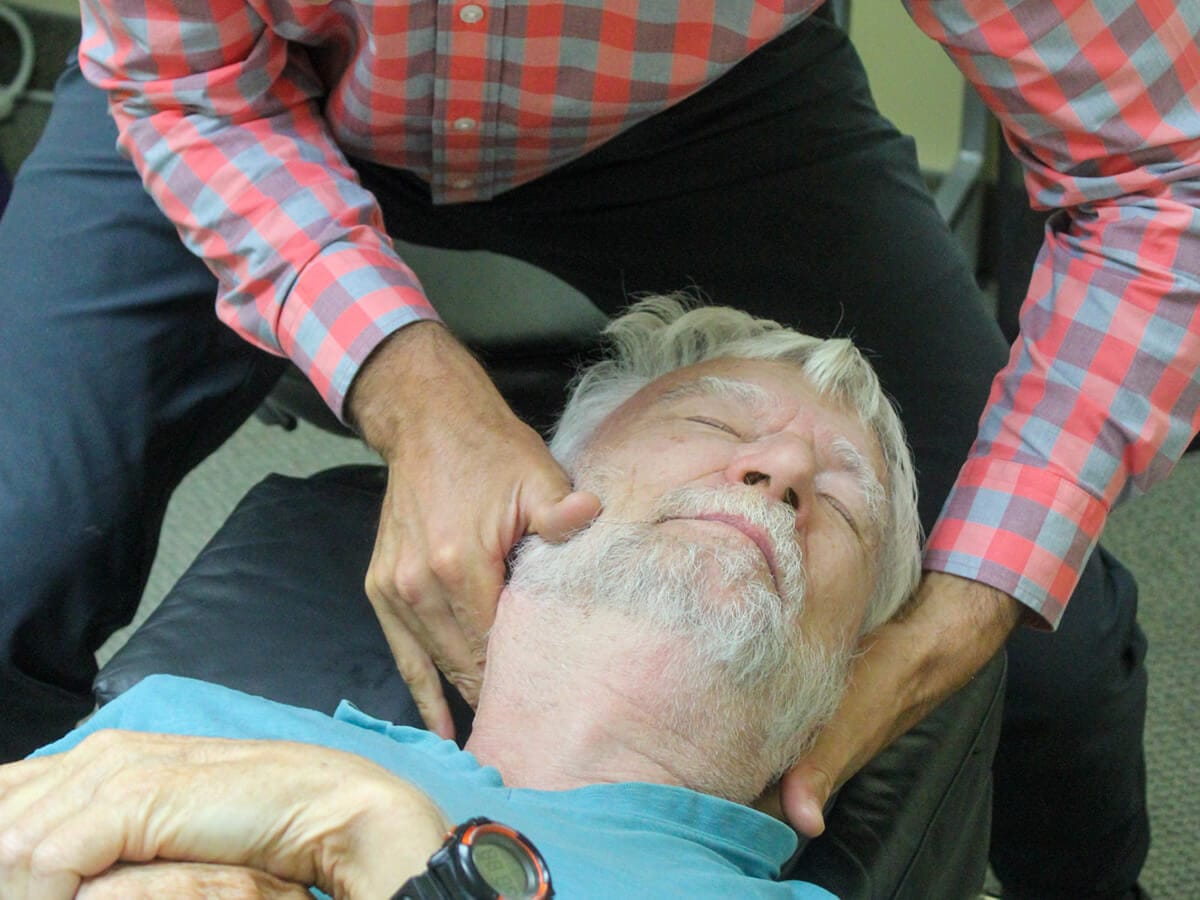
1. Chiropractic Adjustment (Also Known as Spinal Manipulation)
One of the most supported treatments for cervicogenic headaches.
Chiropractic adjustments:
- Reduce physical stress on the nervous system, allowing your body to heal and function as it should.
- Improve cervical joint motion
- Reduce referred nerve irritation
- Decrease protective muscle guarding
- Improve posture and movement patterns
- Reduce headache frequency and severity
Your individualized, gentle, precision-based approach aligns with modern evidence-based care.
2. Suboccipital Release & Soft Tissue Therapy
These muscles are often at the root of the pain pattern.
Benefits include:
- Reduced tension
- Deactivation of trigger points
- Improved blood flow
- Fast symptom reduction
Here’s a video on how to do this yourself!

3. Posture & Ergonomic Correction
Because posture is a primary cause, this is essential for long-term success.
Coaching includes:
- Neutral head and neck positioning
- Desk and screen height adjustments
- Driving ergonomics
- Phone/tablet positioning
- Sleep support strategies
Small corrections dramatically reduce mechanical stress on the neck.
Check out our Posture and Ergonomic videos here!
4. Deep Neck Flexor Strengthening
Research shows strengthening these deep stabilizers significantly reduces cervicogenic headaches.
Here is a great video on how to do this:

5. Upper Thoracic Mobility Exercises
The thoracic spine and neck work together. If the mid-back is stiff, the neck overcompensates.
Mobility work improves:
- Posture
- Breathing
- Neck loading
- Overall spinal mechanics
How Long Does It Take to See Improvement?
Short answer: No way to know for sure – because everyone is different. What I do know is that the more frequent the Chiropractic care initially, the faster the results are seen.
That being said,
Typical timelines:
- 2–4 weeks: Fewer headaches
- 4–8 weeks: Improved mobility and reduced intensity
- 8–12 weeks: Stronger long-term improvements
- 12+ weeks: Stability and prevention of recurrence
Outcomes depend on:
- Duration of symptoms
- Posture habits
- Home exercise consistency
- Stress levels
- Underlying joint or disc changes
ACP & NICE Guidelines Support Conservative Care
Two leading medical guideline bodies emphasize non-surgical care:
- ACP — American College of Physicians
- NICE — National Institute for Health and Care Excellence (UK)
Both recommend:
- Manual therapy (Chiropractic Adjustments)
- Exercise therapy
- Postural modification
- Education
- Avoiding unnecessary imaging or surgery
Research References
- Bogduk N. Cervicogenic headache anatomy. Curr Pain Headache Rep. 2001;5(4):361–365.
https://pubmed.ncbi.nlm.nih.gov/11475320/ - Jull G, et al. Manipulative therapy and exercise for cervicogenic headache. Spine. 2002;27(17):1835–43.
https://pubmed.ncbi.nlm.nih.gov/12221344/ - Fernández-de-Las-Peñas C, et al. Suboccipital trigger points. Clin J Pain. 2006;22(6):512–519.
https://pubmed.ncbi.nlm.nih.gov/16788341/ - Sjaastad O, et al. Diagnostic criteria for cervicogenic headache. Headache. 1998;38(6):442–445.
https://pubmed.ncbi.nlm.nih.gov/9625270/ - Ylinen J, et al. Deep neck flexor strengthening evidence. J Rehabil Med. 2003;35(5):236–243.
https://pubmed.ncbi.nlm.nih.gov/14664390/ - Gross AR, et al. Manual therapy for neck pain/headache — Cochrane review.
https://pubmed.ncbi.nlm.nih.gov/25921885/
Patient Success Story: Headache Relief Through Chiropractic Care
(Shared from a public Google Review)
Rachel E. — 5-Star Google Review
“When I first came to Dr. Nik I was in rough shape. I was having extreme neck pain that resulted in painful headaches which made it hard to concentrate and function. I was really scared at my first appointment due to reading possible risks on Google. Dr. Nik was very understanding and gentle. I’m so glad that I started coming to the clinic.
My symptoms have decreased significantly after only a few months of regular adjustments. It has been so worth the investment. I have more energy, so much less pain, and barely any headaches.
For anyone who is feeling really nervous or scared, Dr. Nik is extremely experienced and genuinely cares about his patients. I no longer feel nervous about my appointments and now look forward to them as I feel better and better as the weeks go by.
I’m looking forward to seeing where I will be in the months to come with continued care. I am so glad I found this clinic. It’s a warm and caring environment and I’m so happy and thankful to be on this healing journey.”
If headaches or neck tension are disrupting your daily life or your child’s, there is a solution.
At Fairway Chiropractic Centre, we focus on finding the root mechanical cause and correcting it through:
- Chiropractic adjustments
- Posture correction
- Deep neck strengthening
Call 519-748-5535 or book online to start your recovery.
Author
Dr. Nik Dukovac, DC Fairway Chiropractic Centre
Trusted provider for headache relief, posture correction, and evidence-based Chiropractic care in Kitchener–Waterloo.