


Quick Answer
Stretching can be very helpful for tight muscles, stiffness, posture, and movement. But stretching is not the same thing as a Chiropractic adjustment.
If your spine is not moving properly, or if your nervous system is irritated because of spinal stress, stretching alone usually will not correct the underlying problem. It may help you feel looser for a short period of time, but it often does not address why the tightness keeps coming back.
At Fairway Chiropractic Centre, we often explain it this way:
Stretching can help the muscles feel better. Chiropractic care helps restore better spinal motion and reduce stress on the nervous system.
Both can be useful, but they are not the same thing.
Why People Ask This Question
Many people in Kitchener, Waterloo, and Cambridge want to take care of their spine naturally. That is a good thing.
You may feel tight in your neck, low back, hips, or shoulders and wonder:
- “Can I just stretch this out myself?”
- “Do I really need to see a Chiropractor?”
- “If I stretch every day, will my spine go back into alignment?”
These are fair questions.
Stretching is simple, inexpensive, and something you can do at home. It can be an important part of taking care of your body. But when it comes to spinal misalignments, joint restrictions, nerve irritation, and repeated patterns of stress, stretching has limits.
What Does a Spinal Misalignment Really Mean?
When Chiropractors talk about a spinal misalignment, we are usually not saying that a bone is dramatically “out of place” like a dislocation.
In many cases, a spinal misalignment refers to a joint that is not moving properly, is under abnormal stress, or is affecting the way the nervous system communicates with the body.
This can happen from many things, including:
- Poor posture
- Repetitive work positions
- Sitting too long
- Old injuries
- Sports strain
- Stress and muscle guarding
- Weakness or poor movement patterns
- Disc irritation
- Sleeping positions
- Lifting incorrectly
The spine is not just a stack of bones. It protects the spinal cord and allows communication between your brain and body. When spinal joints are not moving well, the surrounding muscles often tighten to protect the area.
That is one reason stretching may feel good, but the tightness returns.
Stretching Helps Muscles. Chiropractic Addresses Joint Motion and Spinal Stress.
Stretching mainly affects muscles, tendons, and connective tissue. It can help improve flexibility and range of motion. It can also reduce the feeling of stiffness.
But a Chiropractic adjustment, also known as spinal manipulation, is different.
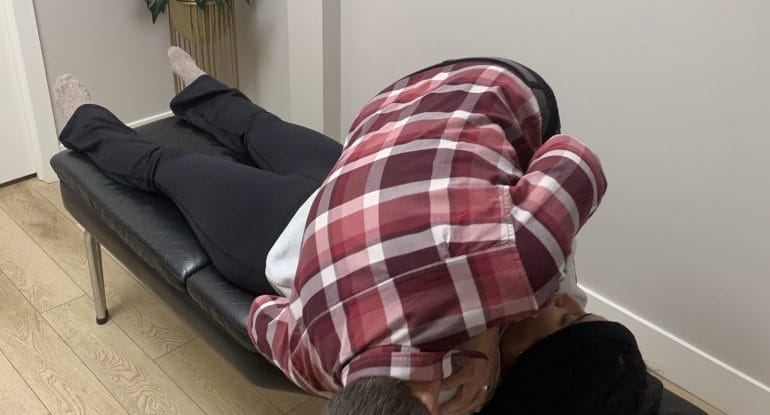
A Chiropractic adjustment is a specific correction applied to a restricted spinal joint. The goal is to improve joint motion, reduce spinal stress, and help the nervous system function better.
Think of it like this:
If a door hinge is stiff, pulling harder on the door may move it a little, but it does not fix the hinge.
In the same way, stretching tight muscles around a restricted spinal joint may help temporarily. But if the joint itself is not moving properly, the body may keep tightening those muscles again and again.
Why Tight Muscles Often Come Back
A common mistake is assuming that tight muscles are always the problem.
Sometimes tight muscles are not the main problem. They are the body’s response to a deeper issue.
For example, if your low back feels tight every morning, you may think your hamstrings or hips simply need more stretching. But the real issue could be spinal joint restriction, poor core endurance, disc irritation, prolonged sitting, or a movement pattern that keeps overloading the same area.
The body is intelligent. It often creates tightness as a protective response.
This is called muscle guarding.
Muscle guarding is when the body tightens muscles around an area to protect it from further stress or injury. Stretching may temporarily reduce the tight feeling, but if the reason for the guarding is still there, the tightness usually returns.
Can Stretching Make Things Worse?
Sometimes, yes.
Gentle stretching is usually safe for many people, but aggressive stretching can irritate certain spinal problems.
This is especially true if you have:
- A disc herniation
- Sciatica
- Numbness or tingling
- Pain going down the arm or leg
- Spinal stenosis
- Sharp pain with bending
- Pain that worsens after stretching
- Instability or repeated flare ups
For example, someone with a disc injury may feel tempted to stretch the hamstrings or bend forward repeatedly. In some cases, that can increase irritation instead of helping.
This is why it is important to understand what your body actually needs. Not every tight back needs more stretching. Sometimes it needs less irritation, better spinal mechanics, improved stability, and the right type of care.
Why Chiropractic Care Is Different
At Fairway Chiropractic Centre, our goal is not simply to chase tight muscles or symptoms.
We want to understand why the problem is there in the first place.
A Chiropractor looks at how your spine is moving, how your posture is loading your body, how your nervous system may be responding, and what movement patterns may be contributing to the issue.
Chiropractic care may help by:
- Improving restricted spinal joint motion
- Reducing spinal stress
- Helping calm protective muscle guarding
- Improving posture and movement awareness
- Supporting better nervous system function
- Helping your body move more efficiently
- Giving you a clearer plan for long term improvement
This is very different from simply stretching the area that feels tight.
Should I Still Stretch?
Yes, in many cases stretching can be helpful.
The key is knowing when to stretch, how to stretch, and whether stretching is the main thing your body needs.
Healthy stretching should feel controlled and comfortable. It should not create sharp pain, numbness, tingling, or symptoms that travel into the arm or leg.
Stretching is often most helpful when it is combined with:
- Chiropractic care
- Posture correction
- Core endurance
- Strengthening
- Better lifting mechanics
- Walking
- Breathing and relaxation
- Better work station habits
- Movement breaks during the day
Stretching is a tool. It is not the whole solution.
A Simple Example
Imagine someone who works at a desk all day.
Their shoulders round forward, their head shifts forward, and the upper back becomes stiff. By the end of the day, their neck feels tight.
They stretch their neck every night. It helps for 20 minutes.
But the next day, the tightness is back.
Why?
Because the daily posture, spinal stress, and restricted movement patterns have not changed.
In this case, stretching may help the symptom, but Chiropractic care may be needed to help restore better motion to the spine and build a better long term strategy. If neck pain like this keeps returning, an assessment can help you understand why.
The Fairway Chiropractic Approach
Our approach is not just, “Where does it hurt?”
We want to know:
- Why is this area being overloaded?
- Is the spine moving properly?
- Is the nervous system irritated?
- Are the muscles tight because they are weak, overworked, or protecting something?
- Are posture and movement patterns contributing?
- What needs to change so this problem does not keep returning?
This is why Chiropractic care is so important.
The power that made the body heals the body. Our job is to help remove the physical barriers that may be interfering with that natural healing ability.
Stretching may help you feel looser. Chiropractic care helps address the spinal stress and movement restrictions that may be driving the problem. When a disc is involved, our Disc Repair approach looks deeper than the symptom.
When Should You See a Chiropractor?
You should consider seeing a Chiropractor if:
- Your tightness keeps coming back
- You feel stiff in the same area repeatedly
- Stretching only gives temporary relief
- You have neck pain, back pain, headaches, or sciatica
- You feel numbness, tingling, or pain into the arm or leg
- Your posture is getting worse
- You feel limited in work, sports, or daily life
- You want to understand the cause of the problem, not just manage the symptom
If you are in Kitchener, Waterloo, or Cambridge and you are wondering whether your tightness is muscular, spinal, postural, or disc related, a Chiropractic assessment can help you understand what is really going on.
Final Thought
So, can you stretch out your spine’s misalignments instead of seeing a Chiropractor?
Usually, no.
Stretching can help tight muscles and improve flexibility, but it does not replace a specific Chiropractic assessment and adjustment when the spine is not moving properly.
The better question is not, “Should I stretch or see a Chiropractor?”
The better question is:
“What does my body actually need to heal and function better?”
For many people, the best answer is a combination of Chiropractic care, better movement, posture correction, strength, and the right home exercises.
At Fairway Chiropractic Centre, our goal is to help you move better, heal naturally, and live out your full God-given potential.
Request a Free Phone Consultation
If you are dealing with recurring tightness, neck pain, back pain, or sciatica in Kitchener, Waterloo, or Cambridge, you can request a free phone consultation with Fairway Chiropractic Centre to find out whether Chiropractic care, stretching, spinal decompression, or another option may be appropriate for your situation. You can also call us at 519-748-5535.
About the Author
Dr. Nik Dukovac, B.Sc., D.C.
Chiropractor | Fairway Chiropractic Centre
Kitchener, Waterloo, Cambridge
Dr. Nik Dukovac has advanced training in spinal neurobiomechanics and focuses on helping patients understand the cause of their problem, not just the symptoms. His approach combines specific Chiropractic care, appropriate-force adjustments, patient education, and collaboration when needed to help patients move better, heal better, and function at their best.
References and Further Reading
- Qaseem A, Wilt TJ, McLean RM, Forciea MA. Noninvasive Treatments for Acute, Subacute, and Chronic Low Back Pain: A Clinical Practice Guideline From the American College of Physicians. Annals of Internal Medicine. 2017;166(7):514-530.
- National Center for Complementary and Integrative Health. Spinal Manipulation: What You Need To Know. National Institutes of Health.
- National Center for Complementary and Integrative Health. 4 Things To Know About Spinal Manipulation for Low-Back Pain. National Institutes of Health.
- Rubinstein SM, de Zoete A, van Middelkoop M, Assendelft WJJ, de Boer MR, van Tulder MW. Benefits and harms of spinal manipulative therapy for the treatment of chronic low back pain: systematic review and meta-analysis of randomised controlled trials. BMJ. 2019;364.
- Paige NM, Miake-Lye IM, Booth MS, et al. Association of Spinal Manipulative Therapy With Clinical Benefit and Harm for Acute Low Back Pain: Systematic Review and Meta-analysis. JAMA. 2017;317(14):1451-1460.
- Hayden JA, Ellis J, Ogilvie R, Malmivaara A, van Tulder MW. Exercise therapy for chronic low back pain. Cochrane Database of Systematic Reviews. 2021;9.
- Bryant J, Fox K, Condon B, et al. The Effects of Static Stretching Intensity on Range of Motion and Strength: A Systematic Review. International Journal of Environmental Research and Public Health. 2023;20(6):4890.
- Olugbade T, Bianchi-Berthouze N, Marquardt N, Williams AC de C. The relationship between guarding, pain, and emotion. Pain Reports. 2019;4(4).
- Fryer G, Morris T, Gibbons P. Paraspinal muscles and intervertebral dysfunction: part two. Journal of Manipulative and Physiological Therapeutics. 2004;27(5):348-357.
- El Sayed M, Callahan AL, Achar S. Mechanical Back Strain. StatPearls. Treasure Island, FL: StatPearls Publishing.