



If you’ve never had a Chiropractic adjustment before, it’s completely normal to wonder:
- What exactly happens?
- Is it forceful?
- Will it hurt?
- Is it the same as cracking my own back or neck?
For many people, uncertainty — not fear — is the biggest barrier to starting care.
So let’s walk through this step by step, clearly and honestly.
Quick Answers
- A Chiropractic adjustment is specific, intentional, and based on assessment
- Location of adjustment may be different from where the pain is located
- It is not the same as cracking your own back or neck
- Adjustments can be very gentle or firmer, depending on the situation
- The cracking sound is gas release, not bones moving
- An adjustment can still work even if no sound is heard
- Improving spinal function is often a process, not a one-time event
Step 1: Nothing Happens Until You’re Assessed
A Chiropractic adjustment is never done blindly.
Before any adjustment, your Chiropractor evaluates:
- Your health history
- Current symptoms
- Posture and movement patterns
- Joint motion
- Neurological and orthopedic findings
- Imaging reports, when appropriate
The goal is not just to ask “Where does it hurt?”
It’s to understand why your body is adapting the way it is.
Only joints that demonstrate restricted or poorly coordinated movement are considered for adjustment. Interestingly, the location of the pain is not always where the key problem with the spine is. This is where a skilled Chiropractor is critical to achieve good, long-lasting results.
Step 2: Choosing the Right Type of Adjustment
There is no single kind of Chiropractic adjustment.
The approach is chosen based on:
- Age
- Bone and joint health
- Nervous system sensitivity
- Diagnosis
- Comfort level
- Patient preference
Adjustments may include:
- Hands-on manual adjustments
- Many variations fall under this category:
- Very gentle
- Firm
- Face down, face up, seated
- Some that you don’t often hear a cracking noise
- Some often do hear a cracking noise
- Many variations fall under this category:
- Instrument-assisted techniques
This is why one person’s experience can look very different from another’s.
Step 3: Positioning & Precision
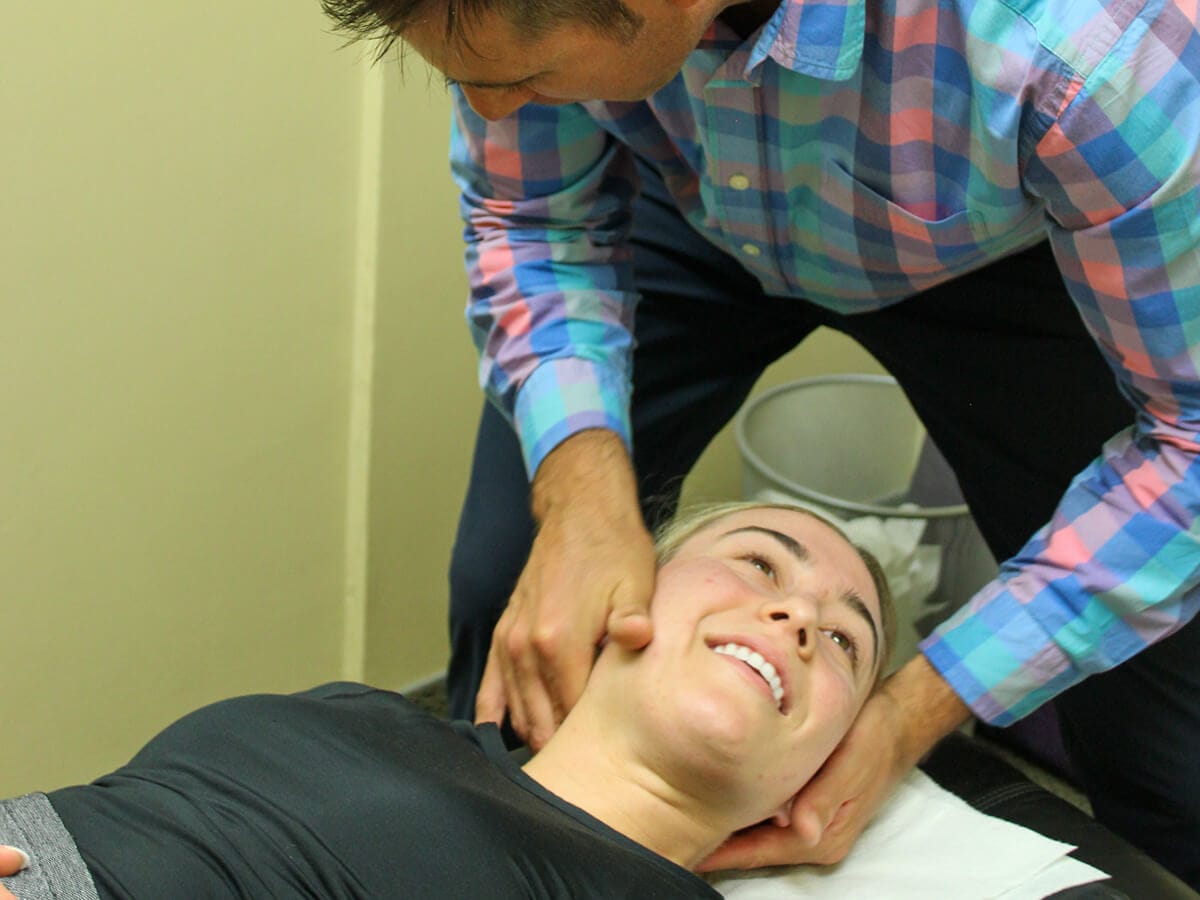
You may be positioned on your back, side, stomach, or seated.
Positioning is designed to:
- Keep you comfortable
- Protect sensitive tissues
- Allow precision
- Reduce unnecessary force
Good Chiropractic care prioritizes accuracy over strength.
Step 4: The Adjustment Itself
A Chiropractic adjustment is a quick, specific movement applied to a joint that is not moving or coordinating properly.
Key points:
- It is targeted, not random
- It uses speed more than force
- It respects joint anatomy and neurological input
- Direction of the adjustment is critical to achieve the best results
**NOTE: If the same technique is used on all the members of an entire family, it may seem to the observer that the Chiropractor is doing the exact same thing on everyone! But this is so far from the truth. The difference is in the specificity of which spinal joint is being adjusted, and the direction of the adjustment force to restore proper movement of a joint ‘stuck’ in a specific way.
The goal is to:
- Improve joint motion
- Reduce abnormal stress on surrounding tissues
- Normalize sensory input to the nervous system
- Allowing the body to function as it should and heal itself
What Is the “Cracking” or “Popping” Sound?
When a sound occurs, it’s called joint cavitation.
It happens when:
- Pressure changes inside the joint
- Dissolved gas (mostly nitrogen) is released from the joint fluid
It is:
- Not bones grinding
- Not joints “going out” or “going in”
Does the adjustment still work if there’s no sound?
Yes — absolutely.
The sound is a side-effect of the adjustment, NOT the marker of success of an adjustment.
That being said –
I know for myself, when I get adjusted, I prefer to hear the cracking noise. It is simply psychological – but it makes me feel like something has happened. I’ve read the research, and I know that I don’t need to hear the noise for successful results of improving their spinal health – but I still prefer to hear it.
On the other hand, I have patients who hate to hear the noise! So in these cases we choose techniques less common to cause this audible crack.
Is a Chiropractic Adjustment the Same as Cracking Your Own Back or Neck?
This is one of the most common — and important — questions.
Cracking your own back or neck:
- Usually happens where movement is already easy
- Often misses the restricted/problem joint
- Lacks assessment and specificity
- Can reinforce the same pattern that’s already “stuck”.
- Because the easiest joint to ‘crack’ is the one that will crack unless you are very precise – and you just can’t do it to yourself (I can’t do it to myself, and I know what I’m doing – I’m a Chiropractor)
- If you keep cracking joints that are already moving well, you may make them hypermobile (move too easily) which could lead to other problems. Chiropractic is only adjusting the joints that are needing to improve – nothing else.
- Often provides short-term relief, and a feeling of needing to keep on doing this throughout the day.
A Chiropractic adjustment:
- Targets specific restricted joints
- Is based on assessment and clinical findings
- Improves motion where the body needs it.
- Influences how the nervous system controls movement
I have countless patients who have told me over the years that their feeling of needing to crack their own neck or back as gone away since starting Chiropractic care. Especially parents telling me that their child no longer cracks their own neck since coming in to see me for Chiropractic care.
In other words: self-cracking is usually a random release.
A Chiropractic adjustment is a specific clinical input.
When Fear Is Part of the Picture
Many patients are understandably nervous before their first adjustment — especially if they’ve heard stories or are worried about the sound.
One patient shared:
“For a long time I was terrified to see a chiropractor. I imagined something going wrong, and even the sound of cracks made me nervous. Little did I know that all those fears — and more importantly, the pain — were going to melt away after my first adjustment.”— Vladana R., Google Review
Feeling heard, informed, and in control matters just as much as the technique itself.
What You Might Feel After an Adjustment
Common experiences include:
- A sense of release or lightness
- Improved movement
- Reduced tension
Temporary responses may include:
- Mild soreness
- Fatigue
- Headache or lightheadedness
These usually reflect the nervous system adapting, similar to starting a new exercise or learning a new movement pattern.
Why Chiropractic Care Is Often a Process — Not a One-Time Fix
This is one of the most misunderstood parts of Chiropractic care.
Your body — especially your nervous system — has memory.
If poor posture, stress, injury, or repetitive habits have been present for months or years:
- Muscles adapt
- Movement patterns become ingrained
- The body defaults to what it knows
Even when movement improves after an adjustment, the body may try to return to its old pattern — not because something is wrong, but because that pattern has become familiar.
This is why improvement often happens:
- Gradually
- Layer by layer
- Over time
Repeated adjustments help:
- Reinforce healthier movement
- Create new neurological “defaults”
- Establish a new, more functional normal
One patient described this process clearly:
“After my first adjustment, I knew that I was on the right track. My pain had mostly subsided, but I needed more adjustments to truly start the healing. Over the next 8 weeks I saw Nik twice a week. My condition has only improved all along the way… I am able to enjoy life better, and feel stronger and more confident that I can trust my back to carry me.”— Collin M., Google Review
And for some people, even the first visit can feel like a turning point:
“My fear of Chiropractic came to an end when I visited Fairway Chiropractic Centre… Dr. Nik Dukovac is very experienced and professional — I immediately felt relieved.”— Meena T., Google Review
Testimonials reflect individual experiences. Results vary. Chiropractic care is personalized and does not guarantee specific outcomes.
The Big Picture of Chiropractic
Adjust Locally, Influence Globally
Here’s the idea that ties everything together.
A Chiropractic adjustment is local — it’s applied to a specific joint.
But the effect can be global, because the spine is not just a stack of bones.
It’s part of the communication system between your brain and body.
When spinal joints aren’t moving properly, the nervous system receives a physiological stress signal, initially resulting in:
- Receive “noisy” or distorted movement input
- Over-guard certain muscles
- Create compensation patterns
- Increase strain in other regions
If the joint stays unhealthy for a long time, and the stress signal persists in your nervous system for a long time, then your body starts to react globally by producing cortisol stress hormones. This leads to long term protective adaptations by your body and Chronic pain, which eventually can affect other systems in the body too.
Restoring good joint movement segmentally in the spine will reverse this cascade of events.
So even though the adjustment is delivered locally, the goal is to influence how the nervous system coordinates the whole body — globally.
Where ADIO fits in (Above-Down, Inside-Out)
At Fairway Chiropractic Centre, care is guided by the ADIO principle:
- Above-Down:The brain and nervous system coordinate the body from the top down — movement, posture, balance, muscle tone, and regulation.
- Inside-Out:The body heals and adapts from within. We don’t “force” healing — we support the conditions that allow the body to do what it’s designed to do.
A Chiropractic adjustment doesn’t heal you by itself.
It’s an input — a signal — that can help the nervous system better:
- Sense where the body is in space
- Coordinate movement more efficiently
- Reduce protective guarding
- Reduce physical stress on the body, and therefore normalising stress hormones caused by the spinal condition.
And because the body can revert to old habits (muscle memory), repeated adjustments are sometimes needed to help establish a new “normal” over time.
Can an Adjustment Ever Feel Like Too Much?
Occasionally, yes — particularly in sensitive nervous systems.
If that happens:
- Care is modified
- Gentler techniques are used
- Progression is slowed
Good Chiropractic care is responsive, respectful, and adaptive.
The Bottom Line
A Chiropractic adjustment is:
- Specific
- Based on the Assessment
- Reducing physical stress on the body and nervous system
- Allowing your body to heal itself.
- A process, not a one-time fix.
It is not the same as cracking your own back or neck, and lasting change most often occurs through a process of repeated, appropriate input — helping your body build a new “normal,” Above-Down, Inside-Out.
Your Next Step
If you’ve been curious about Chiropractic care but unsure what actually happens:
Book a consultation at Fairway Chiropractic CentreWe’ll explain everything clearly, answer your questions, and help you decide what makes sense for you.
Research References
- Kawchuk GN, et al. The audible release associated with spinal manipulation. Spine, 2015
- Pickar JG. Neurophysiological effects of spinal manipulation. The Spine Journal, 2002
- Evans DW. Mechanisms and effects of spinal high-velocity, low-amplitude thrusts. JMPT, 2002
- Haavik H, Murphy B. Altered sensorimotor integration with spinal dysfunction. Experimental Brain Research, 2012
Author
Dr. Nik Dukovac, B.Sc., D.C.Chiropractor | Fairway Chiropractic CentreDr. Nik Dukovac is a Chiropractor serving the Kitchener–Waterloo–Cambridge community with a focus on personalized care. He has advanced training in spinal neurobiomechanics and works extensively with patients experiencing complex conditions such as dizziness, vertigo, disc injuries, and persistent neck-related symptoms that remain unexplained despite imaging or medical testing.
Dr. Dukovac’s approach emphasizes appropriate force Chiropractic adjustment (from very gentle to firm based on age, patient preference and clinical situation), careful clinical assessment, and collaboration with medical providers when appropriate. Guided by the principle that the power that made the body heals the body, he helps patients restore proper movement, improve nervous system function, and regain confidence in their balance and daily activities.
Dr. Nik is actively involved in community health education, youth sports, and helping patients better understand why their symptoms occur — not just how to manage them.