



If you are researching treatment options for a disc injury, chances are you have come across radiofrequency ablation injections, often called RF ablation.
They are commonly described as minimally invasive and effective for reducing pain. For someone struggling with persistent back or neck symptoms, that can sound appealing.
But an important question is rarely asked:
What else is affected when nerves are intentionally disrupted?
Understanding that difference can change how you evaluate your options and why many people choose a conservative, non surgical approach first.
Quick Answers
Do RF injections heal disc injuries?
No. They reduce pain signaling but do not repair or decompress the disc.
Can RF injections affect joint stability?
They may alter proprioceptive feedback, which plays a role in muscle coordination and joint protection.
Is non-surgical spinal decompression safe?
When properly assessed and supervised, it is considered low risk and non-invasive.
Which option should be considered first for disc herniations and disc degenerative disease?
For many patients, conservative care that addresses disc pressure and mechanics is a logical first step.
What Are RF Injections Actually Doing?
Radiofrequency injections work by applying heat to specific spinal nerves, killing them, in order to reduce their ability to transmit pain signals.
The goal is symptom relief.
The disc itself is not repaired.
Mechanical stress on the spine is not reduced.
Pain perception is decreased by altering nerve function.
RF injections are most commonly used for facet joint pain and in select chronic pain cases. When applied to disc related pain, however, the biological trade offs deserve closer examination.
Pain Is Only One Signal the Spine Sends
Spinal nerves do far more than transmit pain.
The discs, joints, ligaments, and deep spinal muscles are rich in mechanoreceptors and proprioceptors. These receptors continuously provide the brain with information about:
- Joint position
- Movement
- Load
- Segmental stability
This sensory feedback, known as proprioception, is essential for coordinated muscle activation and joint protection.
When RF injections disrupt nerve function, pain signals may be reduced, but important sensory feedback is also altered.
Why Proprioception Matters for Long Term Joint Health
Proprioceptive input plays a critical role in spinal stability.
When that feedback is reduced:
- Muscles may activate less precisely
- Protective reflexes can diminish
- Subtle instability may go unnoticed
- Abnormal loading patterns can accumulate over time
Short term pain relief may occur, but the spine may become less protected in the long term, especially if the original disc stress remains unchanged.
This concern is not philosophical. It is grounded in neurophysiology and joint biomechanics.
RF Injections and Disc Injuries: A Mismatch in Many Cases
Disc injuries are mechanical and biological problems.
They often involve:
- Increased intradiscal pressure
- Reduced disc hydration
- Altered movement patterns
- Nerve irritation from compression rather than sensitivity alone
RF injections do not reduce disc pressure.
They do not improve disc nutrition.
They do not restore spinal mechanics.
They reduce nerve signaling.
For some patients, that trade off may be acceptable. For many disc injury cases, however, it raises an important question about long term joint health and function.
A Different Approach: Non Surgical Spinal Decompression Therapy
Non surgical spinal decompression therapy takes a fundamentally different approach.
Rather than silencing nerves, it aims to change the environment those nerves are responding to.
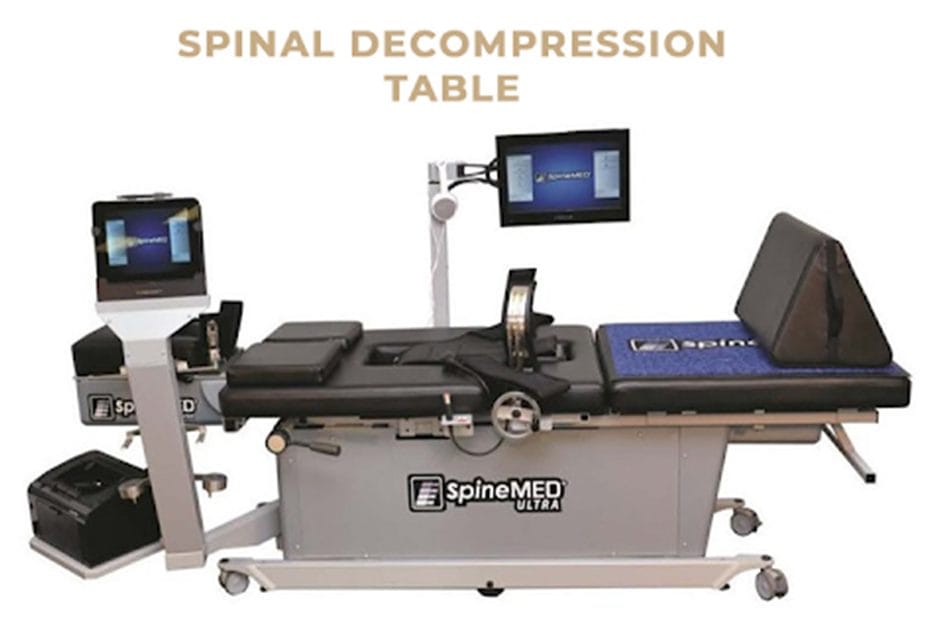
Using a specialized, computer controlled decompression table, gentle traction cycles are applied to the spine to:
- Reduce pressure within injured discs
- Encourage disc rehydration and nutrient exchange
- Reduce bulging or herniation stress
- Decompress irritated spinal nerves
Learn more about how non surgical spinal decompression therapy works and who it may be appropriate for.
Preserving Sensory Feedback Matters
One of the most important distinctions between spinal decompression and RF injections is this:
Spinal decompression preserves normal proprioceptive feedback.
The nervous system remains informed about joint position and movement. Muscles continue to coordinate appropriately. Protective reflexes remain intact.
Pain reduction occurs not because nerves are damaged, but because disc stress is reduced and tissue health improves.
Disc injuries involve pressure, hydration, and movement dysfunction. You can read more about our approach to disc injury assessment and care here.
RF Injection vs Spinal Decompression Therapy
| Feature | RF Injection | Spinal Decompression Therapy |
| Primary goal | Reduce pain signaling | Reduce disc pressure |
| Effect on disc mechanics | No direct effect | Improves disc loading environment |
| Effect on proprioception | May disrupt sensory feedback | Preserves normal sensory input |
| Invasiveness | Invasive procedure | Non invasive |
| Risk profile | Nerve injury, instability concerns, repeat procedures | Low risk when properly supervised |
| Addresses root cause | No | Yes |
| Long term intent | Symptom control | Functional recovery and tissue support |
Why Many Patients Explore Decompression First
In our clinic, we do not provide or recommend RF injections for disc injuries.
This is because for disc related problems, there are safer ways to address the underlying cause.
When given clear information, many patients choose to explore non invasive care that:
- Does not damage nerves
- Supports disc health
- Preserves spinal feedback
- Aligns with long term joint function
If you are exploring conservative options, our Disc Repair Clinic division of Fairway Chiropractic Centre focuses specifically on non surgical strategies designed to reduce disc stress and support recovery.
Peer Reviewed References
- Freeman MA, Wyke B.
The innervation of the lumbar intervertebral disc.
Journal of Bone and Joint Surgery Br. 1967.
- Bogduk N.
The innervation of the lumbar spine.
Spine. 1983.
- Panjabi MM.
The stabilizing system of the spine. Part I and II.
Spine. 1992.
- Riemann BL, Lephart SM.
The sensorimotor system. Part I: The physiologic basis of functional joint stability.
Journal of Athletic Training. 2002.
- Ramos G, Martin W.
Effects of vertebral axial decompression on intradiscal pressure.
Journal of Neurosurgery. 1994.
- Onel D et al.
Computed tomographic investigation of the effect of traction on lumbar disc herniations.
Spine. 1989.
- Gose EE, Naguszewski WK, Naguszewski RK.
Vertebral axial decompression therapy for pain associated with herniated or degenerated discs.
Neurological Research. 1998.
- McGill SM.
Low Back Disorders: Evidence Based Prevention and Rehabilitation.
Human Kinetics.
Final Thought
Disc injuries are not just pain problems.
They are pressure problems, movement problems, and information problems.
Before choosing a treatment that silences signals, it is worth considering whether those signals are protecting something important.
Considering Your Options?
If you are in the Kitchener, Waterloo, or Cambridge area and researching non surgical solutions for disc injury, spinal decompression therapy may be worth exploring.
A thorough assessment helps determine whether it is appropriate for your specific case.
Author
Dr. Nik Dukovac, B.Sc., D.C.
Chiropractor | Fairway Chiropractic CentreDr. Nik Dukovac is a Chiropractor serving the Kitchener–Waterloo–Cambridge community with a focus on personalized care. He has advanced training in spinal neurobiomechanics and works extensively with patients experiencing disc injuries, nerve related pain, and chronic spinal conditions that have not fully responded to conventional care.
His approach emphasizes appropriate force Chiropractic adjustment, careful assessment, and conservative strategies that support long term nervous system and joint health rather than masking symptoms. Guided by the principle that the power that made the body heals the body, Dr. Nik helps patients restore movement, reduce disc stress, and regain confidence in their bodies.