


Jaw Pain and Treatment Options in Kitchener, Waterloo, and Cambridge
Jaw pain, clicking, headaches, facial tension, or discomfort when chewing are often grouped under one term, TMJ disorder, also known as temporomandibular joint dysfunction (TMD).
At Fairway Chiropractic Centre, we regularly see people from Kitchener, Waterloo, and Cambridge who have already tried night guards, exercises, or botox injections, yet their jaw symptoms continue to return.
One of the most common reasons this happens is that TMJ is rarely just a jaw problem. The neck, posture, and nervous system often play a much bigger role than people expect. This is where Chiropractic care can make a meaningful difference.
Quick Answers About TMJ
Can Chiropractic help TMJ disorder?
Yes. Chiropractic care can improve neck function, posture, and nervous system regulation, all of which commonly contribute to TMJ symptoms.
Does Chiropractic involve adjusting the jaw?
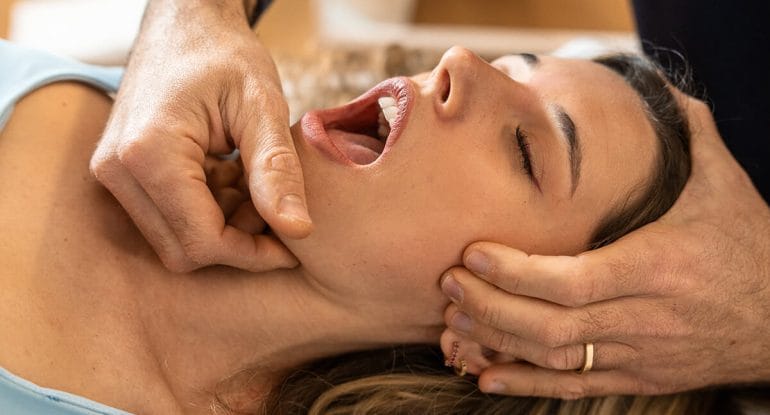
In some cases, gentle jaw adjustments are used. Care focuses on spinal function and gentle jaw related techniques when appropriate.
When should SoftWave therapy be considered?
SoftWave may be helpful when TMJ symptoms persist due to chronic soft tissue irritation or delayed healing despite appropriate Chiropractic care.
Do I need a mouth guard too?
Some patients do. TMJ care is often collaborative and may involve your dentist or medical provider when appropriate.
What Is TMJ Disorder, Really?
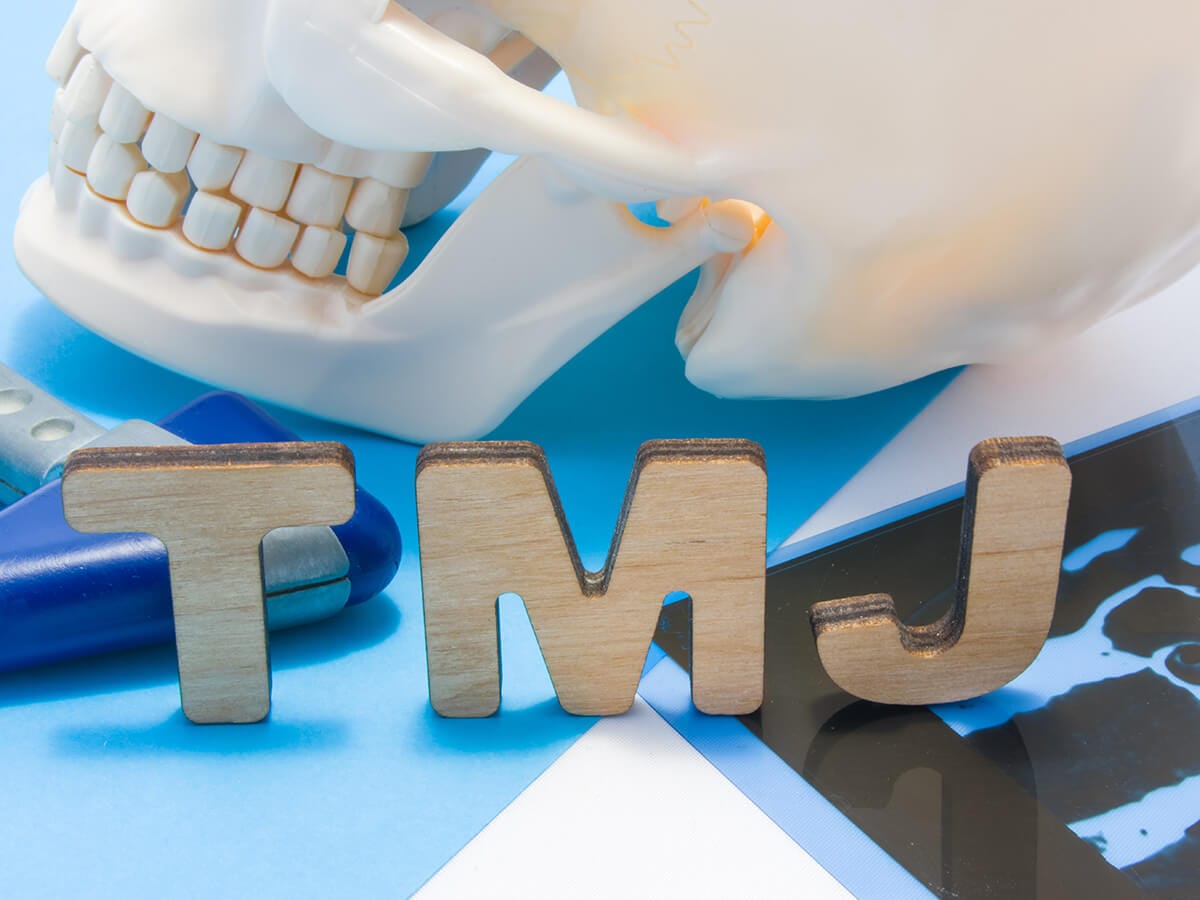
The temporomandibular joints connect your jaw to your skull. These joints help coordinate chewing, swallowing, speaking, yawning, and even how your head and neck sit throughout the day.
When something disrupts that coordination, people may experience jaw clicking or popping, facial or jaw pain, headaches, ear pressure or ringing, neck stiffness, upper back tension, or pain when opening wide or chewing.
In practice, jaw symptoms often reflect stress elsewhere in the body, particularly in the upper neck.
Why the Neck and Spine Matter in TMJ
Shared nerve pathways
The upper cervical spine shares neurological connections with the jaw, face, and head. When joints in this region are not moving well, it can increase jaw muscle tension, change how the jaw coordinates movement, and contribute to facial pain or headaches.
Posture changes jaw mechanics
Forward head posture, which is very common with desk work and phone use, subtly changes the resting position of the jaw. Over time, this increases strain on the temporomandibular joints. Addressing posture and spinal alignment is often essential for long term improvement.
Nervous system regulation
Many people notice their TMJ symptoms worsen during periods of stress. Spinal joint irritation can amplify nervous system tension, increasing clenching, grinding, and muscle guarding around the jaw.
The Role of Chiropractic in TMJ Care
At Fairway Chiropractic Centre, Chiropractic care for TMJ does not involve forcefully pushing the jaw into place.
Instead, care focuses on restoring balance across the entire system. This often includes Chiropractic adjustment, also known as spinal manipulation, to the neck and upper back using an appropriate level of force based on age, comfort, and clinical findings. Gentle jaw or cranial techniques may be used when indicated. Postural stress patterns are addressed, and nervous system irritation that drives muscle tension and clenching is reduced.
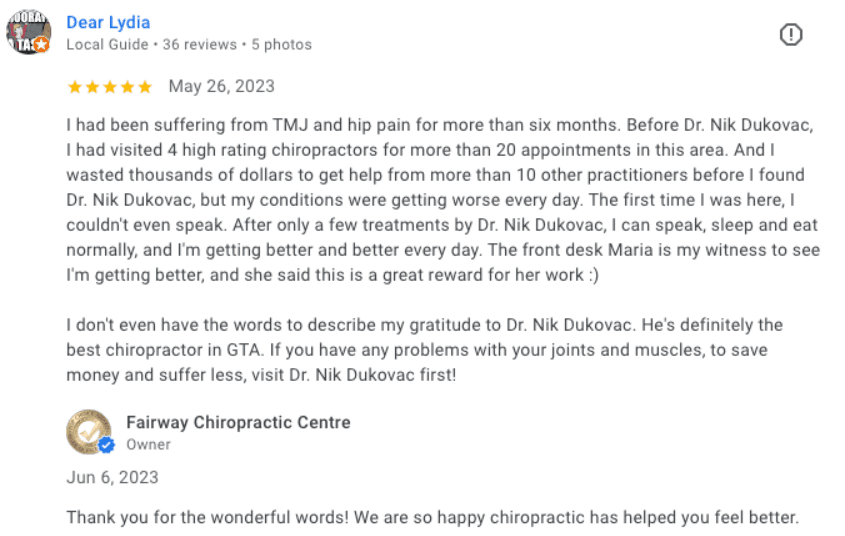
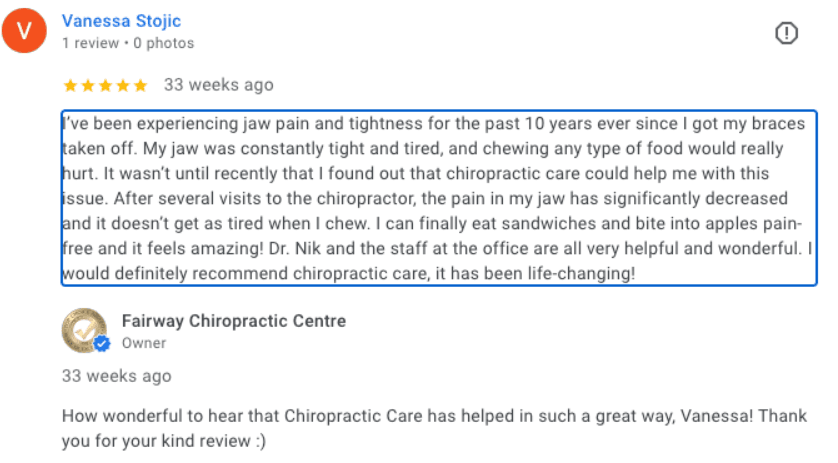
Many patients across Kitchener, Waterloo, and Cambridge report less jaw tension, fewer headaches, reduced clicking or popping, better neck movement, and improved comfort with chewing and speaking.
For a more focused overview, you can also explore our approach to TMJ related Chiropractic care.
When Chiropractic Alone May Not Be Enough
Not all TMJ cases respond at the same pace.
Some people improve quickly with Chiropractic care alone. Others reach a plateau because their symptoms are driven by chronic muscle irritation, long standing inflammation, or sensitive soft tissues around the jaw or upper neck that are slow to heal.
When progress stalls, additional support may be appropriate.
When to Consider SoftWave Therapy for TMJ
When TMJ symptoms persist despite good spinal and postural care, SoftWave Tissue Regenerative Therapy may be considered.
SoftWave is a non invasive technology that uses mechanical signaling to stimulate the body’s natural repair processes in tissues that have become chronically irritated or slow to heal.
In TMJ related cases, SoftWave may help improve local tissue health, reduce chronic inflammation, support healing of irritated muscles and connective tissue, and improve comfort when used alongside Chiropractic care.
At our clinic, SoftWave is used as a complement to Chiropractic care, not a replacement, and only when it fits the clinical picture.
References
- de Wijer A, Steenks MH, Bosman F, Helders PJ, Faber J.
Symptoms of the cervical spine in temporomandibular and cervical spine disorders.
Journal of Oral Rehabilitation. 1996;23(11):742 to 750.
https://pubmed.ncbi.nlm.nih.gov/8951639/ - La Touche R, Paris Alemany A, von Piekartz H, et al.
The influence of cranio cervical posture on pain and disability in patients with myofascial temporomandibular disorders.
Journal of Oral Rehabilitation. 2011;38(10):807 to 815.
https://pubmed.ncbi.nlm.nih.gov/21707530/ - Armijo Olivo S, Magee DJ, Flores Mir C.
Effectiveness of manual therapy and therapeutic exercise for temporomandibular disorders.
Physical Therapy. 2016;96(1):9 to 25.
https://pubmed.ncbi.nlm.nih.gov/26194683/ - Bogduk N.
The anatomy and pathophysiology of neck pain.
Physical Medicine and Rehabilitation Clinics of North America. 2011;22(3):367 to 382.
https://pubmed.ncbi.nlm.nih.gov/21824582/ - Pickar JG.
Neurophysiological effects of spinal manipulation.
The Spine Journal. 2002;2(5):357 to 371.
https://pubmed.ncbi.nlm.nih.gov/14589467/ - Haavik H, Murphy B.
The role of spinal manipulation in addressing disordered sensorimotor integration and altered motor control.
Journal of Electromyography and Kinesiology. 2012;22(5):768 to 776.
https://pubmed.ncbi.nlm.nih.gov/22658695/ - Wang CJ.
Extracorporeal shockwave therapy in musculoskeletal disorders.
Journal of Orthopaedic Surgery and Research. 2012;7:11.
https://pubmed.ncbi.nlm.nih.gov/22433121/
Your Next Step…
If you are dealing with jaw pain, clicking, or facial tension in Kitchener, Waterloo, or Cambridge, book an assessment at Fairway Chiropractic Centre. We will help determine whether Chiropractic care alone or a combined approach including SoftWave therapy is the right next step for you.
Author
Dr. Nik Dukovac, B.Sc., D.C.
Chiropractor | Fairway Chiropractic CentreDr. Nik Dukovac serves the Kitchener, Waterloo, and Cambridge community with a focus on personalized, evidence informed Chiropractic care. He has advanced training in spinal neurobiomechanics and regularly works with patients experiencing complex jaw, neck, and nervous system related conditions.
Guided by the principle that the power that made the body heals the body, Dr. Nik emphasizes appropriate force Chiropractic adjustment, careful assessment, and collaborative care to help patients restore comfort and confidence in daily life.