


Quick Answers
Q: Do I have to keep seeing a chiropractor forever?
No. You only continue chiropractic care for as long as you want the benefit.
Q: Why do some people come regularly long-term?
Because they feel better, move better, function better, and stay more resilient with ongoing care.
Q: What are the stages of chiropractic recovery?
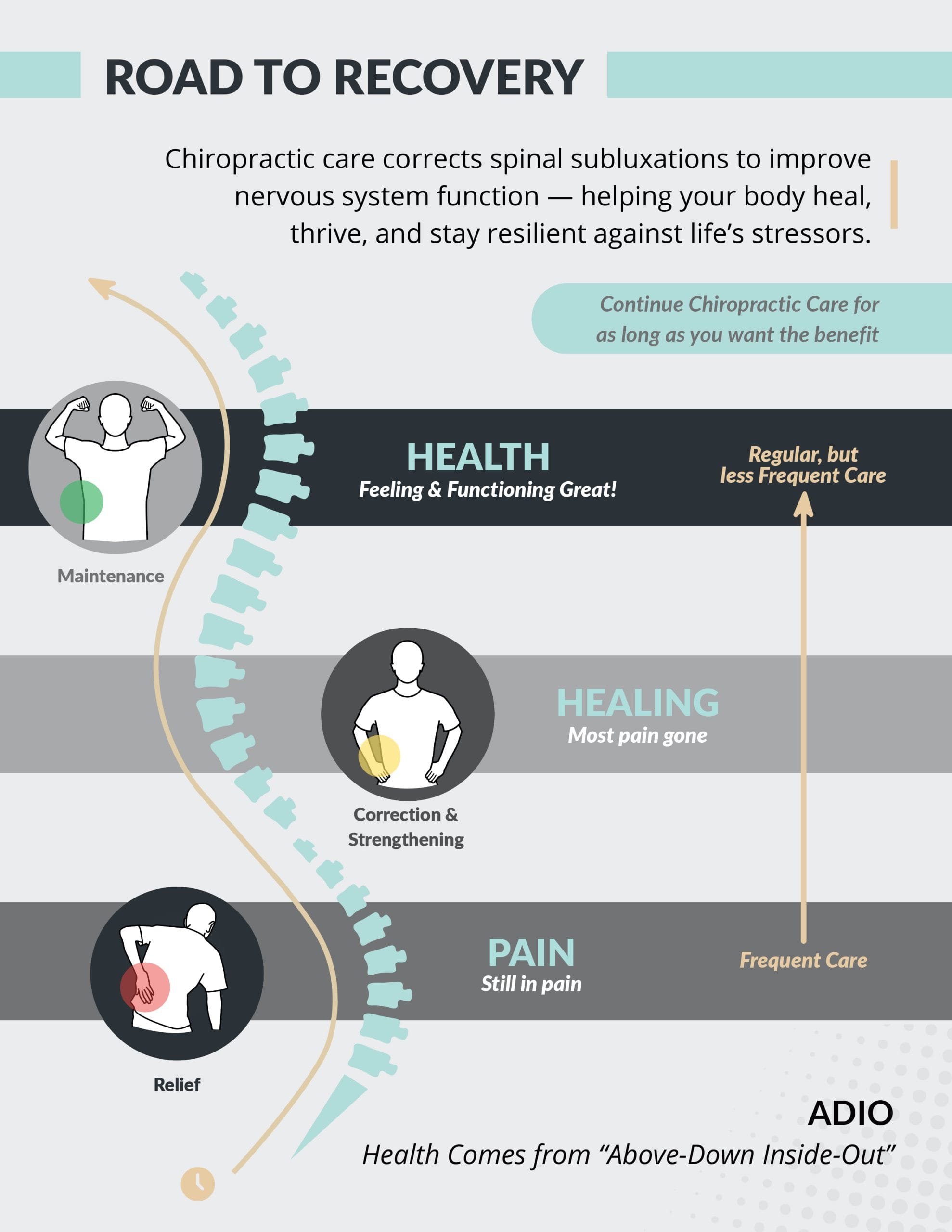
Pain Relief → Healing & Correction → Health & Maintenance (as shown in your Road to Recovery poster).
Q: Is maintenance care mandatory?
No. It is optional and based on your goals, lifestyle, and how you want your spine to function long term.
Q:Is there research to support long-term Chiropractic care?
Yes. There are research articles summarised in a section of this blog.
One of the most common questions new patients ask is:
“Once I start seeing a chiropractor, do I have to go forever?”
The honest answer is simple:
You continue chiropractic care only for as long as you want the benefit.
Chiropractic is not an obligation. It’s a health strategy—much like exercise, nutrition, or dental hygiene.
It’s about increasing the resilience of your body to handle the stressors of life; meaning, the less physical stress on your nervous system, the more stress you handle before your body falls apart.
Let’s Talk About the Chiropractic Road to Recovery
Phase 1: Pain Relief – “Get Me Out of Pain Fast”
In the Pain phase (bottom of the Road to Recovery poster), you are typically still hurting and needing more frequent care. Improvement often happens quickly because this phase focuses on:
- Reducing inflammation
- Restoring movement
- Relieving nerve irritation
- Improving joint mechanics
This is the shortest phase. As pain decreases, visit frequency decreases.
Phase 2: Healing, Correction, and Strengthening – “Most Pain Gone”
The Healing phase (middle of the poster) represents the point where pain is mostly gone, but deeper stability is still needed. Stopping care in this phase is like quitting rehab early —feeling better does not mean the injury is finished healing.
Many find it strange to continue coming in for this phase because we are ingrained since childhood that you only go to the doctor when you have a problem. So when most of the pain is gone, you assume the problem is gone, so why keep going to see your chiropractor when you are feeling great? Well, things are not yet healed – it’s just good enough that the pain signal to your brain has finally stopped ringing.
During this phase we focus on:
- Restoring full joint function
- Rebuilding spinal stability
- Reinforcing proper movement patterns
- Correcting posture and load management
- Reducing the likelihood of relapse
Visit frequency decreases as healing progresses.
Phase 3: Health & Maintenance – “Feeling and Functioning Great”
The top of the poster shows the Health phase—where patients feel their best, move optimally, and stay ahead of flare-ups.
Patients in this phase usually tell us things like:
- “I just feel better when I stay on track.”
- “My back doesn’t seize up anymore.”
- “I recover faster from workouts.”
- “I can sit, lift, and work without stiffness.”
- “Not only is my back feeling great, I have more energy, better focus, and just overall feel so much better.”
The graphic states clearly:
“Continue chiropractic care for as long as you want the benefit.”
Maintenance care is optional. You choose it because it supports your lifestyle, not because you are required to.
Why So Many Patients Choose Ongoing Chiropractic Care
People often continue occasional chiropractic visits long-term because they experience:
- Fewer flare-ups
- Better mobility and flexibility
- Less stiffness with work or sports
- Better posture and movement awareness
- Improved resilience to stress
- Easier recovery from daily strain
Most patients come every 1-2 weeks, others every 2-4wks, and others only during high-stress periods.
There is no one-size-fits-all formula.
It is based on what you value for your spine and your health.
Personally, I get a spinal checkup weekly, and I check my family’s spine weekly also.
What Does the Research Say About Maintenance Chiropractic Care?
Maintenance or preventive chiropractic care is not about “coming forever.” It’s about reducing recurrence, improving function, and keeping the spine healthy over time. It’s about increasing the resilience of your body to handle the stressors of life; meaning – the less physical stress on your nervous system, the more it can handle before your body falls apart.
Several peer-reviewed studies support the value of ongoing care—especially for people with recurrent or chronic episodes of back pain. Here are a few:
1. Fewer Days of Back Pain Over the Long Term
A three-year randomized controlled trial in PLOS ONE found that patients receiving scheduled maintenance chiropractic care had significantly fewer days of bothersome low back pain compared to those who only sought care when symptoms got severe.
Reference: Eklund et al., PLOS ONE (2018).
2. Lower Recurrence Rates and Better Long-Term Function
A randomized clinical trial in the Journal of Manipulative and Physiological Therapeutics found that maintenance care reduced recurrence, lowered flare-up frequency, and improved function compared to stopping care after initial improvement.
Reference: Senna & Machaly, JMPT (2011).
3. Better Disability and Stability Scores Over Time
Research published in Spine demonstrated that patients receiving ongoing spinal manipulation alongside exercise had better disability outcomes at 10 months compared to those receiving short-term acute care only.
Reference: Descarreaux et al., Spine (2004).
4. Best Outcomes for Recurrent or Fluctuating Pain Patients
A 2020 secondary analysis concluded that patients with a history of recurrent or fluctuating low back pain responded best to maintenance care, showing fewer symptom spikes over the year.
Reference: Eklund et al., Chiropractic & Manual Therapies (2020).
5. Superior Pain Relief Compared to Exercise Alone
A trial in The Spine Journal found that long-term chiropractic manipulation outperformed exercise-only programs for pain reduction and function.
Reference: Goncalves et al., The Spine Journal (2018).
What This Means for You
The evidence is clear: you don’t “need” maintenance care forever, but many people benefit from it—just like consistent dental cleanings, stretching routines, or strength training. Maintenance care keeps the spine functioning at its best and reduces the likelihood of relapse.
I’ve definitely found the following to be true with those who keep coming in for Chiropractic maintenance care (including myself):
- It doesn’t mean you’ll never get back pain flare ups again. But they happen much less frequently, and when they happen, you recover much quicker compared to those who don’t continue with maintenance care.
How Often Should You Come After You’re Feeling Better?
This is entirely based on:
- Your goals
- Your daily loads and stresses
- The severity and history of your injury
- Your lifestyle
- Your preferred level of performance
Some patients stop after relief.
Some complete correction.
Many continue regular maintenace care.
All are valid options.
Your plan is personalized to you.
Your Wellness, Your Choice: Care for the Results You Want
Chiropractic care is not something you are required to do forever. You continue care only for as long as you want the benefit. Whether you want fast relief, deeper correction, or long-term resilience, we support you using evidence-based care, a personalized plan, and the Road to Recovery framework.
Book Your Assessment
Fairway Chiropractic Centre / Disc Repair Clinic
We will assess your spine, movement, and goals to determine the right care plan for you.
Phone: 519-748-5535
Or book your appointment here.
Serving Kitchener – Waterloo – Cambridge
Author
Dr. Nikola Dukovac, Chiropractor
Owner of Fairway Chiropractic Centre & Disc Repair Clinic
McGill Method–trained disc injury clinician