


Quick Answers
Q: What is Disc Degenerative Disease? DDD is NOT simply an age-related condition. If degeneration were caused only by aging, all spinal joints would deteriorate evenly. But they don’t. DDD occurs when specific joints experience years of improper load, poor mechanics, repetitive stress, or past injury, leading to localized wear—while other joints of the same age remain perfectly healthy.
Q: Is DDD treatable? Yes. While Chiropractic alone cannot reverse disc aging, we can significantly reduce pain, restore mobility, improve function, and slow further degeneration with the right care.
Q: What treatments work best? A combination of Chiropractic care, SpineMED Spinal Decompression, McGill Method rehabilitation, and targeted lifestyle strategies deliver the strongest outcomes. Even with patients showing increase in Disc Height.
Q: Does DDD lead to surgery? Rarely. Most people get excellent results with conservative treatments.
Q: Can DDD progression be slowed? Absolutely. Movement retraining, posture correction, strength-building, and decompression therapies reduce unhealthy loading on discs and slow future degeneration.
What Is Disc Degenerative Disease?
Disc Degenerative Disease occurs when spinal discs experience chronic overload, shearing, micro-trauma, or poor biomechanics over many years. While time plays a role, time alone is not the cause.
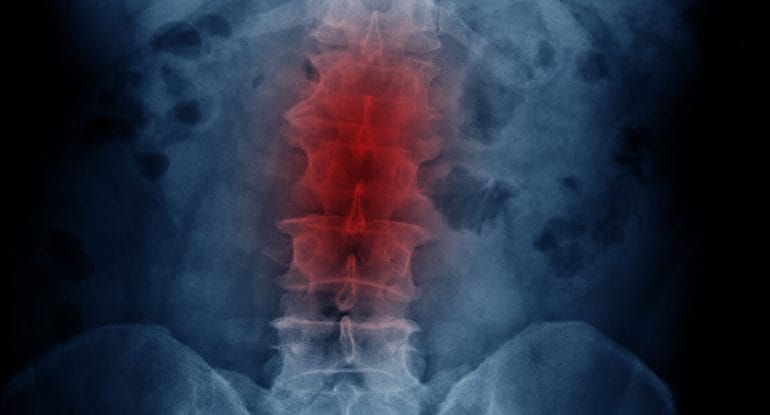
If DDD were simply caused by aging, then every disc in your spine would show equal degeneration. But that’s not what X-rays or MRIs show.
A Common Misconception: “It’s Just Age.” No — It’s Load
This is one of the most important points for patients to understand.
When reviewing X-rays with patients, I often show them two spinal joints:
- One joint with moderate or severe degeneration
- A joint directly above it that appears perfectly healthy
Then I explain:
“These two joints were born on the exact same day. If degeneration were purely caused by age, both joints would look equally worn. But they don’t. That means something more than aging is at play.”
What actually drives localized degeneration?
- Years of poor mechanics
- Repetitive bending or compression
- Old injuries
- Weak stabilizing muscles
- Prolonged sitting or flexion
- Unhealthy loading patterns
- Lifestyle factors (e.g., smoking, obesity)
Scientific literature supports this:
- Abnormal load and mechanical stress are major predictors of disc degeneration (Adams & Roughley, Spine, 2006).
- Poor movement patterns and repeated flexion increase disc strain and speed up degeneration (Callaghan & McGill, Clinical Biomechanics, 2001).
- Occupational loading strongly correlates with segmental degeneration (Battié et al., Spine Journal, 2009).
So yes — time matters, but it is “time + poor load,” not time alone.
This is also why people in their 20s may show early degeneration, and why many 70-year-olds show little or none.

A Real Patient Story: The Power of Understanding Your X-Rays
Many patients come to me after being told, “You have severe arthritis. You’ll have to live with it.”
They were given a label but no understanding, no options, and no path forward.
In my office, we pull up the X-rays together on a large screen. I show them the affected joint, then show a healthy joint nearby. Seeing both — side-by-side — is often the first time they understand their condition.
I tell them:
“If nothing in your life changes, then yes — you will have to learn to live with this. But if you change how your spine is loaded, how you move, how you strengthen, and how you decompress the spine, your outcome can be very different.”
Many patients with moderate or even severe degeneration regain mobility, reduce pain, and return to activities they thought they lost. Their X-rays may stay the same — but their life does not.
I use the analogy of a rusty hinge:
“The hinge may still look rusty, but lubrication allows it to move smoothly.”
Chiropractic adjustments, decompression therapy, and better movement mechanics “lubricate” spinal joints — resulting in major improvements in function.
Symptoms of Disc Degenerative Disease
You may experience:
- Morning stiffness
- Pain that improves with movement
- ain that worsens with prolonged sitting/standing
- Loss of mobility
- Radiating pain into hips, buttocks, or legs
- Recurrent flare-ups
Treatment Options for Disc Degenerative Disease
Below are the strongest, evidence-based options for treating DDD.
1. Chiropractic Care (Chiropractic Adjustment)
Benefits include:
- Restoring joint mobility
- Reducing abnormal load
- Improving biomechanics
- Reducing nerve irritation
- Improving muscle recruitment
- Decreasing inflammation
Patients often say, “I didn’t realize how stiff I’d become until I started moving again.”
2. SpineMED Non-Surgical Spinal Decompression
Research shows decompression reduces intradiscal pressure, improves disc hydration, and reduces nerve compression (Gose et al., Neurological Research, 1998).
Benefits include:
- Reduced pain
- Improved disc function
- Better nutrient exchange
- Less nerve irritation
- Increased mobility
- In some cases, increase in disc height
Ideal for:
- Disc bulges
- Disc herniations
- Foraminal stenosis
- Chronic degenerative pain
3. McGill Method–Based Rehabilitation
The McGill Method focuses on removing pain triggers and building a resilient spine through:
- Spine-sparring movement
- Core stabilization
- Glute strengthening
- Hip mobility
- Proper load management
McGill’s research demonstrates that repeated flexion and poor motor control accelerate disc degeneration (McGill, Low Back Disorders, 2015).
A Second Story That Illustrates This Perfectly
When I practiced in Australia, I treated a man in his early 80s who hadn’t been able to raise his right arm above shoulder height for more than 10 years. He loved keeping his hair neatly slicked back and always carried a comb in his back pocket — even though he couldn’t reach his head.
Decades earlier he was told:
“You have severe arthritis. Learn to live with it.”
And he did — for far too long.
After a few weeks of care, he walked into my office, reached behind him, pulled out the comb, and effortlessly slicked his hair back.
He paused.
He smiled.
Then frustration washed over him.
Not at me — but at the decades of life he felt robbed of because he believed nothing could be done.
That moment was a powerful reminder:
Degeneration on an X-ray does not determine your destiny. Function can return even when the image does not change.
4. Lifestyle & Posture Modifications
Changes include:
- Hip-hinging
- Ergonomic adjustments
- Using lumbar support
- Micro-breaks
- Weight management
5. Targeted Exercise & Strength Training
Effective, research-supported strategies:
- McGill Big 3
- Isometric core training
- Glute strengthening
- Walking
- Hip mobility
Strength protects the spine and limits degenerative stress.
6. Anti-Inflammatory & Medical Options
(This is outside the scope of Chiropractic, and I do not promote this. However, it is important that you are aware of your options.) Medications may be helpful short-term but do not address mechanical causes.
7. Injections (Selective Cases)
Epidural steroids, facet injections, and medial branch blocks may reduce inflammation but are temporary solutions.
8. Surgery (Rarely Needed)
Reserved for:
- Progressive neurological deficit
- Severe unresponsive pain
- Structural instability
Can Disc Degenerative Disease Improve?
Absolutely. Even when the X-ray doesn’t change, mobility, pain levels, resilience, and quality of life can improve dramatically.
DDD is not something you simply “live with.”
It’s something you manage, improve, and often overcome.
Peer-Reviewed References
Adams MA, Roughley PJ. What is intervertebral disc degeneration, and what causes it? Spine. 2006.
Battié MC et al. The twin study of disc degeneration: the role of genetics, environmental and mechanical factors. Spine Journal. 2009.
Callaghan JP, McGill SM. Intervertebral disc herniation: studies on a porcine model. Clinical Biomechanics. 2001.
Gose EE, Naguszewski WK, Naguszewski RK. Vertebral axial decompression therapy for pain. Neurological Research. 1998.
(More references can be added on request.)
Author
Dr. Nikola Dukovac, Chiropractor Owner of Fairway Chiropractic Centre & Disc Repair Clinic.
A McGill Method–trained clinician with extensive experience treating Disc Degenerative Disease and complex spinal conditions. Dr. Dukovac has published peer-reviewed Chiropractic research, spoken at professional and community events on spine health, and mentored multiple Chiropractors in clinical reasoning and spinal rehabilitation.