


What You Need to Know Before Getting Adjusted
If you’ve been diagnosed with a disc herniation, or even just told you have a “bulging disc,” it’s very common to wonder:
- Could Chiropractic make this worse?
- Could an adjustment cause the disc to slip more?
- Should I avoid being adjusted altogether?
These are valid concerns — and they deserve a clear, honest answer.The short answer is:
Chiropractic care should not make a disc herniation worse when it is done appropriately.Let’s unpack what matters most.
Quick Answers
- A disc herniation is not a disc “slipping out”
- Chiropractic adjustment does not push discs back in
- The wrong force, direction, or timing could aggravate symptoms
- Appropriate-force Chiropractic care is often modified for disc injuries
- Many patients experience reduced pain and improved function under the right care
- Disc recovery is usually a process, not a single visit
First — What Is a Disc Herniation, Really?
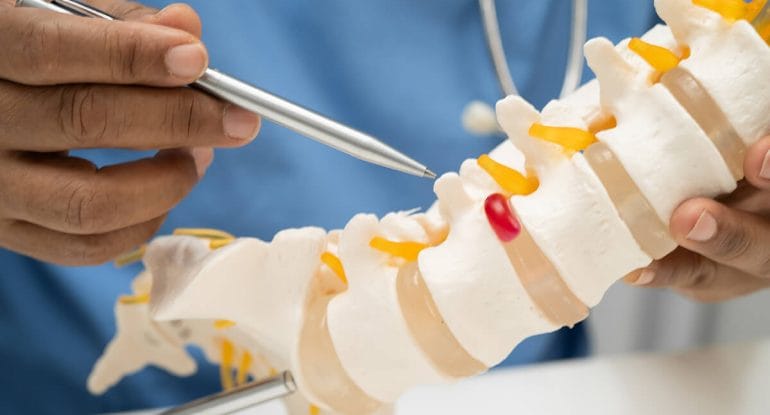
A disc sits between two spinal bones and acts as a shock absorber.A disc herniation occurs when:
- The outer fibres of the disc weaken or tear
- The inner disc material bulges or protrudes outward
- Nearby nerves may become irritated or compressed
Important clarification:
The disc does not “pop out” or “slip.” It is a pressure and tissue integrity issue, not a loose structure.
Why People Worry About Chiropractic and Disc Herniations
Most fear comes from:
- Imagining the spine being “twisted”
- Seeing aggressive techniques online
- Not understanding how force and direction are controlled
- Hearing stories without context
The concern isn’t unreasonable — disc injuries demand respect.
Can a Chiropractic Adjustment Make a Disc Herniation Worse?
The honest answer: It depends on how care is delivered.
Here’s how we ensure no disc injury takes place:
- Proper detailed assessment (including reviewing imaging such as Xrays/MRI/CT)
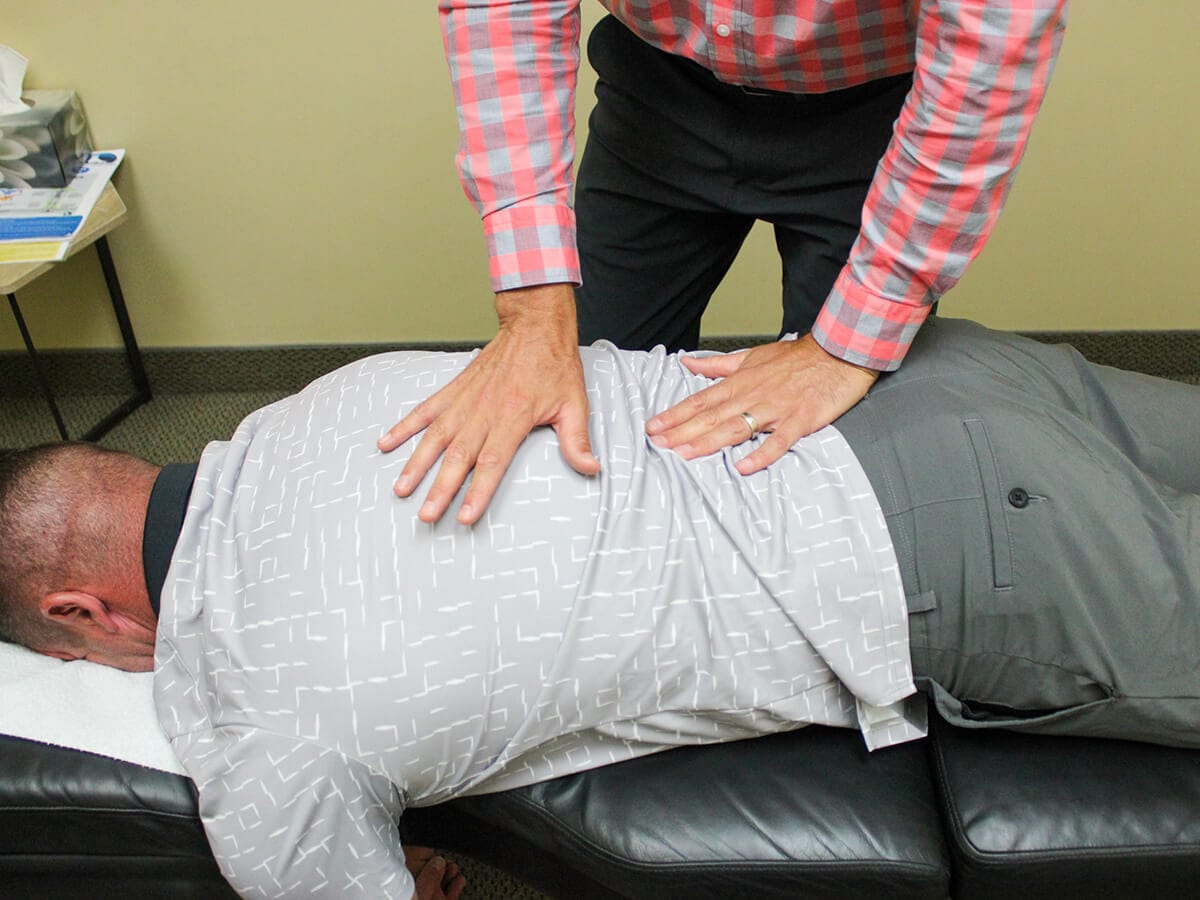
- Wisely choosing which joints of the spine to adjust.
- At times, we need to gradually work toward the key problem by working on other segments of the spine first. And as the body improves over time with each adjustment over the following weeks, then the ability to address the key joint becomes easier — with less guarding, and more comfort, making it safe at that time to work on.
- Patient position before performing the adjustment is critical. Choosing a position that is comfortable is important.
- Use the appropriate amount of force.
- Start with gentle force, see how the patient responds the next day, and then adapt appropriately.
When done appropriately, Chiropractic care is designed to:
- Reduce abnormal spinal stress
- Improve joint motion around the disc
- Reduce nerve irritation
- Improve how the nervous system controls movement
- Allow the disc environment to calm and heal
A Key Point Most Patients Don’t Realize
The area of pain is often NOT the area being adjusted.In disc herniation cases:
- Pain may be in the leg or arm
- The irritated nerve may be several levels away
- The adjustment is often applied above or below the injured disc, not directly on it
This is where clinical skill matters most.
What “Appropriate-Force” Chiropractic Means for Disc Injuries
At Fairway Chiropractic Centre, disc cases are approached differently.Care may involve:
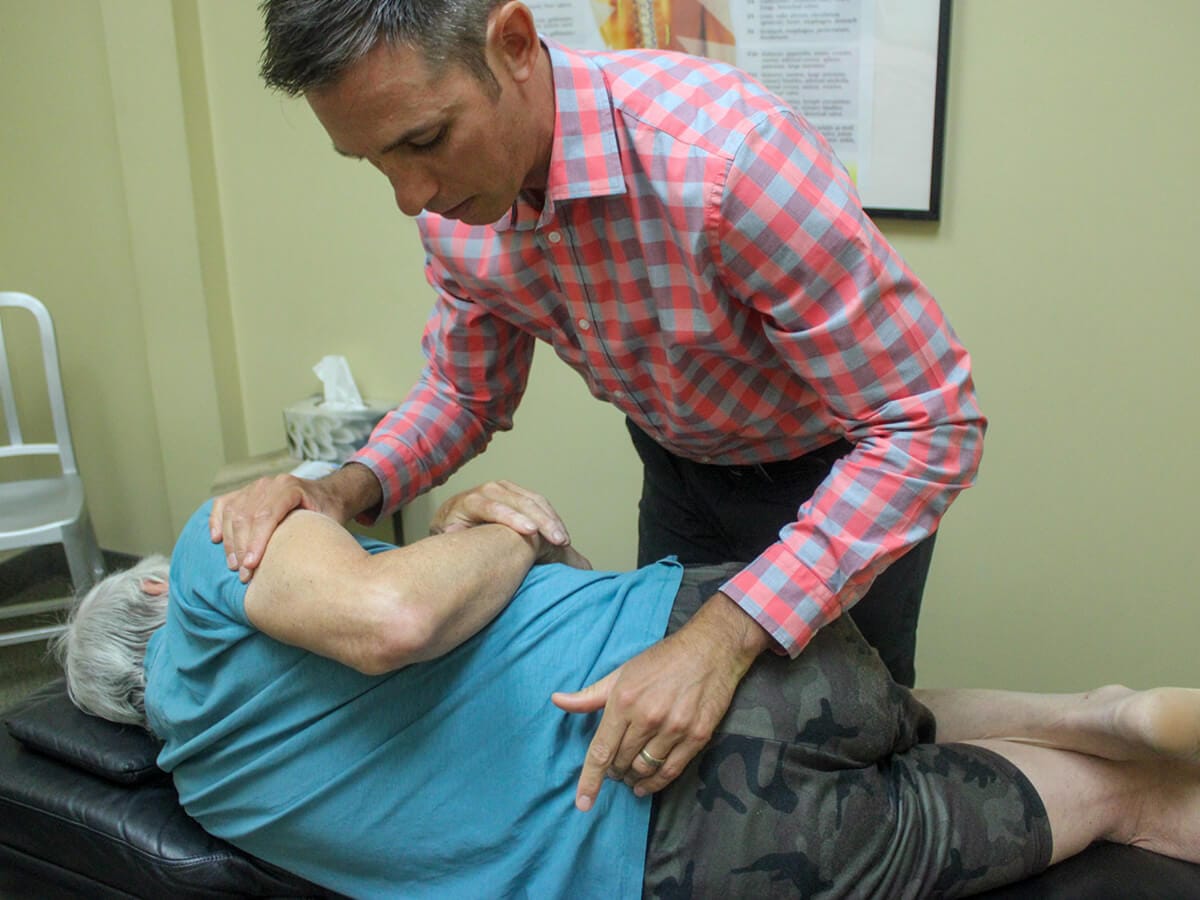
- Gentle, low-force adjustments
- Very specific directional vectors
- Avoiding direct pressure into the injured segment
- Supporting surrounding spinal motion
- Allowing the nervous system to de-stress
This is not about forcing movement — it’s about removing stress, until movement can be improved.
Will the Adjustment Push the Disc Back In?
No.A Chiropractic adjustment:
- Does not push the disc
- Does not squeeze it
- Does not reposition disc material
Instead, it works by:
- Improving joint mechanics
- Reducing abnormal pressure
- Improving movement coordination
- Allowing the disc to gradually rehydrate and remodel over time
Why Disc Recovery Is a Process (Not a Single Visit)
This is one of the most important concepts.When a disc has been injured:
- The nervous system becomes protective
- Muscles tighten and guard
- Movement patterns change
- The spine adapts to avoid pain
Even if pain improves quickly, the body often:
- Tries to return to old patterns
- Re-loads the disc unintentionally
- Needs repeated input to build a new “normal”
That’s why improvement typically happens:
- Gradually
- Layer by layer
- Over weeks to months, not days
What Patients Commonly Notice With the Right Care
Many disc-injury patients report:
- Reduced leg or arm pain
- Improved mobility
- Less muscle guarding
- Better confidence in movement
- Less fear of re-injury
Not always instantly — but progressively.
When Chiropractic Care May NOT Be Appropriate
There are times when Chiropractic care should be:
- Modified
- Deferred
- Or coordinated with medical care
Examples include:
- Progressive neurological weakness
- Loss of bowel or bladder control
- Severe or worsening numbness
- Signs of spinal instability
A responsible Chiropractor will screen for these and refer when needed.
The Big Picture: Adjust Locally, Influence Globally
A Chiropractic adjustment is local — applied to a specific spinal segment.But the effect can be global.When spinal joints aren’t moving well:
- The nervous system receives stress signals
- Muscles over-guard
- Movement becomes inefficient
- Disc loading increases
By restoring healthier spinal mechanics:
- Physical stress is reduced
- Nervous system tone normalizes
- The body can heal Above-Down, Inside-Out
This is not about “fixing” a disc —
It’s about creating the right environment for healing.
So… Will Chiropractic Make My Disc Herniation Worse?
When done appropriately — no.That’s why:
- Assessment matters
- Force matters
- Direction matters
- Timing matters
- Experience matters
Disc injuries deserve precision, patience, and respect.
Your Next Step
If you’ve been diagnosed with a disc herniation and are unsure whether Chiropractic care is safe for you: Book a consultation at Fairway Chiropractic Centre / Disc Repair ClinicWe’ll assess your case carefully, explain your options clearly, and help you decide what approach makes sense for your spine.
Research References
Kawchuk GN, et al. Forces associated with spinal manipulation. Spine, 2013
Pickar JG. Neurophysiological effects of spinal manipulation. The Spine Journal, 2002
Bronfort G, et al. Non-surgical treatment of lumbar disc herniation. Spine Journal, 2004
Leininger B, et al. Conservative management of lumbar disc herniation. Journal of Orthopaedic & Sports Physical Therapy, 2011
Author
Dr. Nik Dukovac, B.Sc., D.C.
Chiropractor | Fairway Chiropractic CentreDr. Nik Dukovac is a Chiropractor serving the Kitchener–Waterloo–Cambridge community with a focus on personalized care. He has advanced training in spinal neurobiomechanics and works extensively with patients experiencing complex conditions such as disc herniations, dizziness, vertigo, and persistent spine-related symptoms that remain unexplained despite imaging or medical testing.Dr. Dukovac’s approach emphasizes appropriate-force Chiropractic adjustment (from very gentle to firm based on age, patient preference and clinical situation), careful clinical assessment, and collaboration with medical providers when appropriate. Guided by the principle that the power that made the body heals the body, he helps patients restore proper movement, reduce physical stress on the nervous system, and regain confidence in their daily activities.Dr. Nik is actively involved in community health education, youth sports, and helping patients better understand why their symptoms occur — not just how to manage them.