


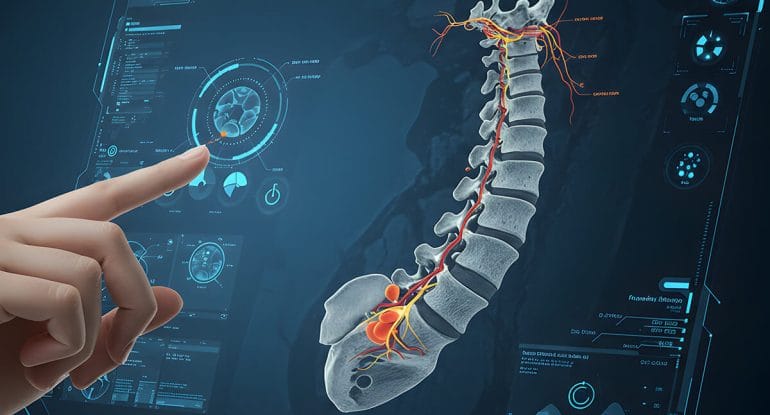
What Artificial Intelligence Gets Right, What It Misses, and Why Your Spine Is Different
Artificial intelligence is everywhere.
From workout plans to diet advice to symptom checkers, many people now turn to AI tools when back pain shows up. Type in “lower back pain causes” or “best treatment for disc injury” and within seconds you will get confident, well worded answers.
But here is the real question:
Can AI actually understand your spine?
And more importantly, can it guide healing, not just information?
Why AI Advice Feels So Convincing
AI is excellent at pattern recognition.
It analyzes massive amounts of data and identifies what commonly shows up together. That makes it useful for:
- Explaining anatomy
- Listing common causes of pain
- Summarizing research
- Offering general education
For someone early in their search, this can feel empowering.
But spinal pain is not a generic problem. It is a biological, mechanical, and neurological problem happening in a specific human body.
That distinction matters.
What AI Gets Right About Back Pain
AI often correctly highlights that back pain can involve:
- Muscles and joints
- Intervertebral discs
- Nerves
- Posture and movement habits
- Stress and lifestyle factors
It may suggest conservative care before surgery, which aligns with evidence based guidelines. It may also encourage activity over prolonged rest, which is generally sound advice.
As an educational starting point, AI can be helpful.
The limitation begins when information is mistaken for understanding.
What AI Cannot See or Feel
AI does not:
- Assess spinal motion
- Palpate joint restriction
- Observe movement compensation
- Evaluate nervous system tone
- Distinguish cause from adaptation
Two people with the same MRI findings can have completely different pain experiences, movement patterns, and recovery paths.
AI cannot determine:
- Which joint is not moving
- Which disc is overloaded
- Which muscles are compensating
- Whether pain is protective or pathological
Back pain is rarely just a diagnosis. It is a functional problem.
Above Down Inside Out Perspective on Healing
From an Above Down Inside Out perspective, healing does not come from the outside fixing the body.
It comes from the nervous system coordinating repair, movement, and adaptation from within.
Pain is not simply something to eliminate.
It is feedback.
AI tends to approach back pain from an Outside In lens:
- Identify diagnosis
- Match it to a treatment
- Reduce symptoms
That model often ignores how the spine actually functions as part of a living, adaptive system.
Why One Size Advice Often Fails
AI advice is based on averages.
Your spine is not average.
Factors AI cannot personalize include:
- Previous injuries
- Occupational loading
- Sport or activity demands
- Movement habits
- Nervous system sensitivity
- Healing capacity
This is why people often say:
“I tried everything I read online and nothing worked.”
Not because the advice was wrong, but because it was not specific enough.
Chiropractic Care Fills the Gap AI Cannot
Chiropractic care is not about replacing information.
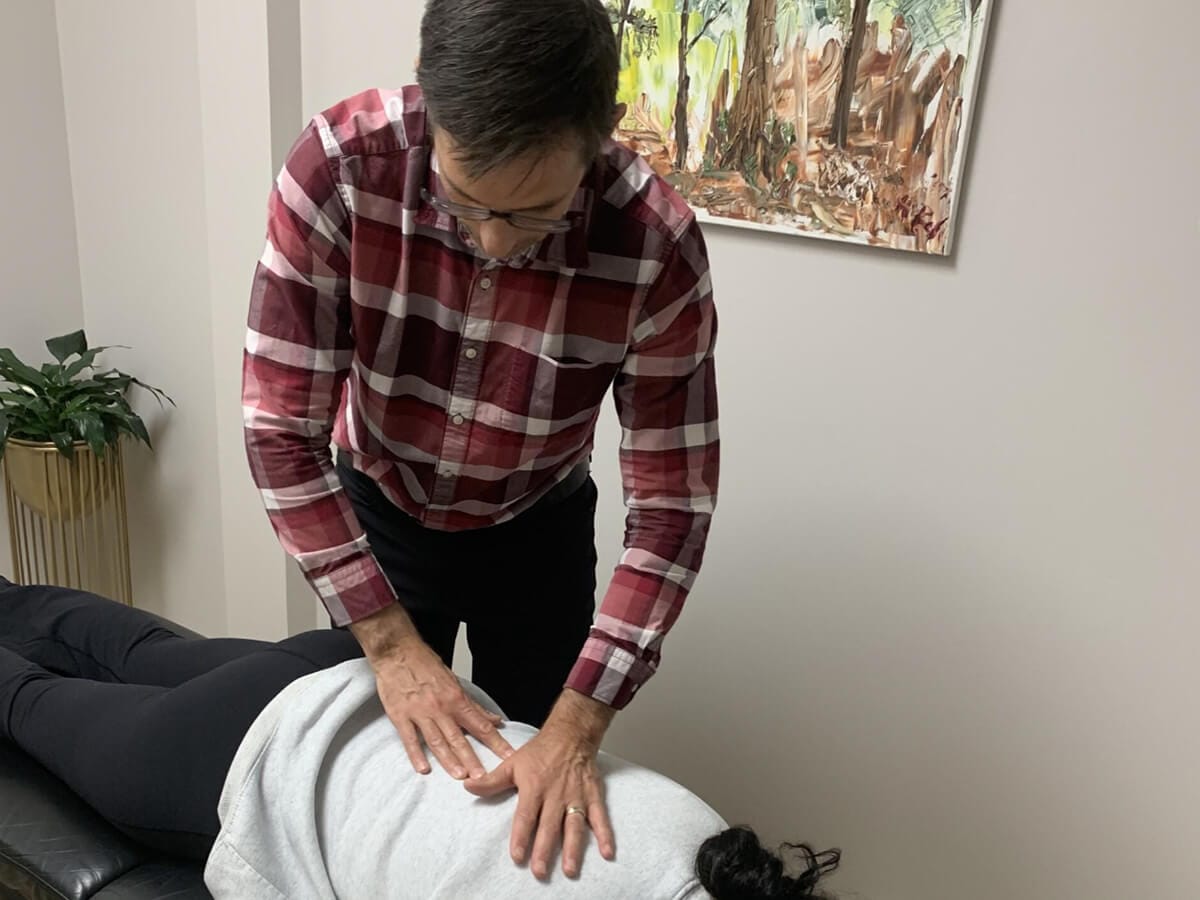
It is about assessing function in real time.
A Chiropractic assessment evaluates:
- How spinal joints move
- Where motion is lost
- How muscles coordinate
- How the nervous system responds to stress
- How load is distributed through the spine
This allows care to be individualized, not generalized.
You can learn more about how we approach Chiropractic care as a functional, nervous system centered process.
Disc Injuries Are a Good Example
AI can explain disc herniations well.
What it cannot do is determine:
- Whether disc pressure is still present
- How movement is stressing the disc
- Whether symptoms are improving or compensating
- Which conservative strategy fits your case
Disc injuries are mechanical problems that require mechanical assessment.
This is why many patients benefit from approaches such as disc injury assessment and care and, in appropriate cases, non surgical spinal decompression therapy.
These decisions cannot be made by algorithms alone.
Common Patient Questions About AI and Back Pain
Is AI dangerous for back pain advice?
AI is not inherently dangerous, but relying on it as a substitute for assessment can delay appropriate care.
Can AI diagnose my back problem?
AI can suggest possibilities, not diagnoses. Diagnosis requires clinical evaluation and context.
Should I stop using AI tools?
No. Use AI for education, not decision making.
Think of AI as a research assistant, not your healthcare provider.
Why does my back pain not match what I read online?
Because pain is influenced by movement, nervous system regulation, and individual adaptation, not just anatomy.
Where AI and Chiropractic Work Best Together
AI can:
- Educate
- Summarize research
- Help patients ask better questions
Chiropractic care can:
- Assess function
- Restore motion
- Improve nervous system coordination
- Support the body’s healing capacity
Used together appropriately, information and hands on care complement each other.
Peer Reviewed References
- Panjabi MM.
The stabilizing system of the spine. Part I and II.
Spine. 1992. - Bogduk N.
Clinical anatomy of the lumbar spine and sacrum.
Churchill Livingstone. - Hartvigsen J et al.
What low back pain is and why we need to pay attention.
The Lancet. 2018. - Riemann BL, Lephart SM.
The sensorimotor system and functional joint stability.
Journal of Athletic Training. 2002. - McGill SM.
Low Back Disorders: Evidence Based Prevention and Rehabilitation.
Human Kinetics.
Final Thought
AI can tell you what usually happens.
It cannot tell you what is happening in you.
Your spine is not a data set. It is a living system guided by the nervous system.
When back pain persists, the most valuable step is not another search, but a proper functional assessment that respects how the body heals from the inside out.
Considering a More Personal Approach?
If you are in the Kitchener, Waterloo, or Cambridge area and looking for answers beyond generic advice, a comprehensive Chiropractic assessment can help clarify what your spine actually needs.
Information is powerful.
Understanding is transformative.
Author
Dr. Nik Dukovac, B.Sc., D.C.
Chiropractor | Fairway Chiropractic CentreDr. Nik Dukovac is a Chiropractor serving the Kitchener–Waterloo–Cambridge community with a focus on spinal function, nervous system health, and conservative care strategies. His approach emphasizes appropriate force Chiropractic adjustment, detailed assessment, and helping patients understand why their symptoms occur, not just how to manage them.
Guided by the principle that the power that made the body heals the body, Dr. Nik helps patients move better, feel stronger, and regain confidence in their bodies.